


Page 1015 - Hall et al (2015) Principles of Critical Care-McGraw-Hill
P. 1015
746     PART 5: Infectious Disorders


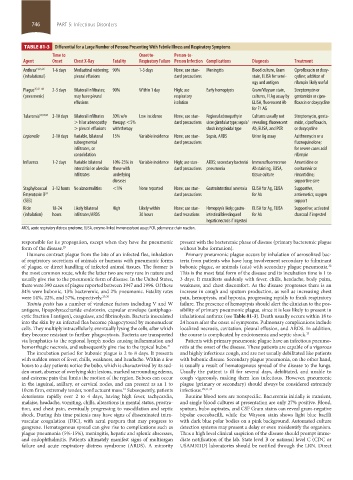
                   TABLE 81-3    Differential for a Large Number of Persons Presenting With Febrile Illness and Respiratory Symptoms
                            Time to                      Onset to-   Person-to-
                  Agent     Onset  Chest X-Ray  Fatality  Respiratory Failure Person Infection Complications  Diagnosis  Treatment
                  Anthrax 14,25,26    1-6 days  Mediastinal widening;   90%  1-3 days  None; use stan-  Meningitis  Blood culture, Gram   Ciprofloxacin or doxy-
                  (inhalational)   pleural effusions                 dard precautions           stain, ELISA for serol-  cycline; addition of
                                                                                                ogy and antigen  rifampin likely useful
                  Plague 35,42–44    2-3 days  Bilateral infiltrates;   90%  Within 1 day  High; use   Early hemoptysis  Gram/Wayson stain,   Streptomycin or
                  (pneumonic)      may have pleural                    respiratory                cultures, Fl Ag assay by  gentamicin or cipro-
                                   effusions                           isolation                ELISA, fluorescent Ab   floxacin or doxycycline
                                                                                                for F1 AG
                  Tularemia 53,55,58  2-10 days  Bilateral infiltrates   30% w/o   Low incidence  None; use stan-  Regional adenopathy in   Cultures usually not   Streptomycin, genta-
                                   > hilar adenopathy  therapy; <5%   dard precautions ulcer glandular type; sepsis/  revealing; fluorescent   micin, ciprofloxacin,
                                   > pleural effusions  with therapy            shock in typhoidal type  Ab, ELISA, and PCR  or doxycycline
                  Legionella  2-10 days  Variable, bilateral   15%  Variable incidence  None; use stan-  Sepsis, ARDS  Urine Ag assay  Azithromycin or a
                                   subsegmental                      dard precautions                         fluoroquinolone;
                                   infiltrates, or                                                            for severe cases add
                                     consolidation                                                            rifampin
                  Influenza  1-2 days  Variable bilateral   10%-25% in   Variable incidence  High; use stan-  ARDS; secondary bacterial  Immunofluorescence   Amantidine or
                                   interstitial or alveolar  those with   dard precautions pneumonia  Ab staining, ELISA,      oseltamivir or
                                   infiltrates  underlying                                      tissue culture    rimantidine;
                                                diseases                                                        supportive care
                  Staphylococcal  3-12 hours No abnormalities  <1%  None reported  None; use stan-  Gastrointestinal anorexia ELISA for Ag, ELISA   Supportive,
                  Enterotoxin B                                      dard precautions           for Ab          antiemetics, oxygen
                         24
                  (SEB)                                                                                       support
                  Ricin     18-24   Likely bilateral   High  Likely within   None; use stan-  Hemoptysis likely; gastro-  ELISA for Ag, ELISA   Supportive; activated
                  ( inhalation)  hours    infiltrates/ARDS  30 hours  dard recautions  intestinal bleeding and   for Ab  charcoal if ingested
                                                                                hepatic necrosis if ingested
                 ARDS, acute respiratory distress syndrome; ELISA, enzyme-linked immunosorbent assay; PCR, polymerase chain reaction.

                 responsible for its propagation, except when they have the pneumonic   present with the bacteremic phase of disease ( primary bacteremic plague
                 form of the disease. 29                               without bubo formation).
                   Humans contract plague from the bite of an infected flea, inhalation   Primary pneumonic plague occurs by inhalation of aerosolized bac-
                 of respiratory secretions of animals or humans with pneumonic forms   teria from patients who have lung involvement secondary to fulminant
                 of plague, or direct handling of infected animal tissues. The former is   bubonic plague, or animals (cats) with secondary plague pneumonia.
                                                                                                                          32
                 the most common route, while the latter two are very rare in nature and   This is the most fatal form of the disease and its incubation time is 1 to
                 usually give rise to the pneumonic form of disease. In the United States,   3 days. It manifests suddenly with fever, chills, headache, body pains,
                 there were 390 cases of plague reported between 1947 and 1996. Of these   weakness, and chest discomfort. As the disease progresses there is an
                 84% were bubonic, 13% bacteremic, and 2% pneumonic. Fatality rates   increase in cough and sputum production, as well as increasing chest
                 were 14%, 22%, and 57%, respectively. 29,30           pain, hemoptysis, and hypoxia, progressing rapidly to frank respiratory
                   Yesinia pestis has a number of virulence factors including V and W   failure. The presence of hemoptysis should alert the clinician to the pos-
                 antigens, lipopolysaccharide endotoxin, capsular envelope (antiphago-  sibility of primary pneumonic plague, since it is less likely to present in
                 cytic fraction I antigen), coagulase, and fibrinolysin. Bacteria inoculated   inhalational anthrax (see Table 81-3). Death usually occurs within 18 to
                 into the skin by an infected flea become phagocytosed by mononuclear   24 hours after the onset of symptoms. Pulmonary complications include
                 cells. They multiply intracellularly, eventually lysing the cells, after which   localized necrosis, cavitation, pleural effusion, and ARDS. In addition,
                 they become resistant to further phagocytosis. Bacteria are transported   the course is complicated by endotoxemia and septic shock. 33
                 via lymphatics to the regional lymph nodes causing inflammation and   Patients with primary pneumonic plague have an infectious pneumo-
                 hemorrhagic necrosis, and subsequently give rise to the typical bubo. 31  nitis at the onset of the disease. These patients are capable of a vigorous
                   The incubation period for bubonic plague is 2 to 8 days. It presents   and highly infectious cough, and are not usually debilitated like patients
                 with sudden onset of fever, chills, weakness, and headache. Within a few   with bubonic disease. Secondary plague pneumonia, on the other hand,
                 hours to a day patients notice the bubo, which is characterized by its sud-  is usually a result of hematogenous spread of the disease to the lungs.
                 den onset, absence of overlying skin lesions, marked surrounding edema,   Usually the patient is ill for several days, debilitated, and unable to
                 and extreme pain that limits the motion of the region. Buboes can occur   cough vigorously, making them less infectious. However, pneumonic
                 in the inguinal, axillary, or cervical nodes, and can present as an 1 to   plague (primary or secondary) should always be considered extremely
                 10 cm firm, extremely tender, nonfluctuant mass.  Subsequently, patients   infectious. 29,31,33
                                                    31
                 deteriorate rapidly over 2 to 4 days, having high fever,   tachycardia,   Routine blood tests are nonspecific. Bacteremia initially is transient,
                   malaise, headache, vomiting, chills, alterations in mental status, prostra-  and single blood cultures at presentation are only 27% positive. Blood,
                 tion, and chest pain, eventually progressing to vasodilation and septic   sputum, bubo aspirates, and CSF Gram stains can reveal gram-negative
                 shock. During this time patients may have signs of disseminated intra-  bipolar coccobacilli, while the Wayson stain shows light blue bacilli
                 vascular coagulation (DIC),  with  acral  purpura  that may  progress  to   with dark blue polar bodies on a pink background. Automated culture
                 gangrene. Hematogenous spread can give rise to complications such as   detection systems may present a delay or even misidentify the  organism.
                 plague pneumonia (5%-15%), meningitis, hepatic and splenic abscesses,   Thus a high level clinical suspicion of the disease should prompt imme-
                 and endophthalmitis. Patients ultimately manifest signs of multiorgan   diate notification of the lab. State level B or national level C (CDC or
                 failure and acute respiratory distress syndrome (ARDS). A  minority   USAMRIID) laboratories should be notified through the LRN. Direct


            section05_c74-81.indd   746                                                                                1/23/2015   12:37:44 PM

