


Page 1117 - Hall et al (2015) Principles of Critical Care-McGraw-Hill
P. 1117
756     PART 6: Neurologic Disorders


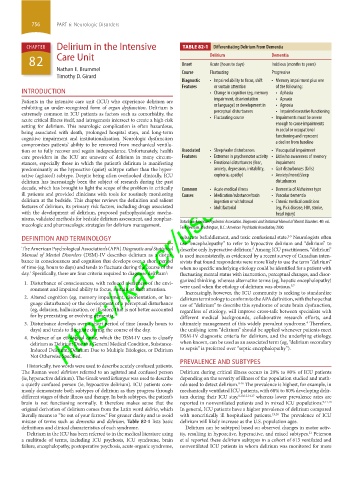
                   CHAPTER   Delirium in the Intensive                   TABLE 82-1    Differentiating Delirium From Dementia
                    82       Care Unit                                  Onset    Delirium             Dementia
                                                                                 Acute (hours to days)
                                                                                                      Insidious (months to years)
                             Nathan E. Brummel                          Course   Fluctuating          Progressive
                             Timothy D. Girard
                                                                        Diagnostic   •  Impaired ability to focus, shift    •  Memory impairment plus one
                                                                        Features   or sustain attention  of the following:
                 INTRODUCTION                                                    •  Change in cognition (eg, memory   •  Aphasia
                 Patients in the intensive care unit (ICU) who experience delirium are   impairment, disorientation    •  Apraxia
                 exhibiting an under-recognized form of organ dysfunction. Delirium is   or language) or development in   •  Agnosia
                                https://kat.cr/user/tahir99/
                 extremely common in ICU patients as factors such as comorbidity, the     perceptual  disturbances  •  Impaired executive functioning
                 acute critical illness itself, and iatrogenesis intersect to create a high-risk   •  Fluctuating course  •  Impairments must be severe
                 setting for delirium. This neurologic complication is often hazardous,                 enough to cause impairments
                 being associated with death, prolonged hospital stays, and long-term                   in social or occupational
                   cognitive impairment and institutionalization. Neurologic dysfunction                  functioning and represent
                 compromises patients’ ability to be removed from mechanical ventila-                   a decline from baseline
                 tion or to fully recover and regain independence. Unfortunately, health   Associated   •  Sleep/wake disturbances  •  Visuospatial impairment
                 care providers in the ICU are unaware of delirium in many circum-  Features  •  Extremes in psychomotor activity •  Little/no awareness of memory
                 stances, especially those in which the patient’s delirium is manifesting   •  Emotional disturbances (fear,   impairment
                   predominantly as the hypoactive (quiet) subtype rather than the hyper-    anxiety, depression, irritability,   •  Gait disturbances (falls)
                 active (agitated) subtype. Despite being often overlooked clinically, ICU   euphoria, apathy)  •  Anxiety/mood/sleep
                 delirium has increasingly been the subject of research during the past                   disturbances
                 decade, which has brought to light the scope of the problem in critically   Common   •  Acute medical illness  •  Dementia of Alzheimer type
                 ill patients and provided clinicians with tools for routinely monitoring   Causes  •  Medication/substance/toxin   •  Vascular dementia
                 delirium at the bedside. This chapter reviews the definition and salient     ingestion or withdrawal  •  Chronic medical conditions
                 features of delirium, its primary risk factors, including drugs associated   •  Multifactorial  (eg, Pick disease, HIV, stroke,
                 with the development of delirium, proposed pathophysiologic mecha-                     head injury)
                 nisms, validated methods for bedside delirium assessment, and nonphar-
                 macologic and pharmacologic strategies for delirium management.  Data from American Psychiatric Association. Diagnostic and Statistical Manual of Mental Disorders. 4th ed.
                                                                       Text Revision. Washington, D.C.: American Psychiatric Association; 2000.
                                                                                                            2-5
                 DEFINITION AND TERMINOLOGY                            subacute befuddlement, and toxic confusional state.  Neurologists often
                                                                       use “encephalopathy” to refer to hypoactive delirium and “delirium” to
                 The American Psychological Association’s (APA) Diagnostic and Statistical   describe only hyperactive delirium.  Among ICU practitioners, “delirium”
                                                                                                6
                 Manual of Mental Disorders (DSM)-IV describes delirium as a distur-  is used inconsistently, as evidenced by a recent survey of Canadian inten-
                 bance in consciousness and cognition that develops over a short period   sivists that found respondents were more likely to use the term “delirium”
                 of time (eg, hours to days) and tends to fluctuate during the course of the   when no specific underlying etiology could be identified for a patient with
                 day.  Specifically, there are four criteria required to diagnose delirium : 1  fluctuating mental status with inattention, perceptual changes, and disor-
                    1
                   1.  Disturbance of consciousness, with reduced awareness of the envi-  ganized thinking, whereas alternative terms (eg, hepatic encephalopathy)
                                                                                                             5,7
                    ronment and impaired ability to focus, sustain or shift attention.  were used when the etiology of delirium was obvious.
                                                                         Increasingly, however, the ICU community is seeking to standardize
                   2.  Altered cognition (eg, memory impairment, disorientation, or lan-  delirium terminology to conform to the APA definition, with the hope that
                    guage disturbance) or the development of a perceptual disturbance   use of “delirium” to describe this syndrome of acute brain dysfunction,
                    (eg, delusion, hallucination, or illusion) that is not better accounted   regardless of etiology, will improve cross-talk between specialists with
                    for by preexisting or evolving dementia.           different medical  backgrounds,  collaborative research efforts, and
                   3.  Disturbance develops over a short period of time (usually hours to   ultimately management of this widely prevalent syndrome.  Therefore,
                                                                                                                  4
                    days) and tends to fluctuate during the course of the day.  the unifying term “delirium” should be applied whenever patients meet
                   4.  Evidence of an etiological cause, which the DSM-IV uses to classify   DSM-IV diagnostic criteria for delirium, and the underlying etiology,
                    delirium as Delirium Due to a General Medical Condition, Substance-  when known, can be used as an associated term (eg, “delirium secondary
                    Induced Delirium, Delirium Due to Multiple Etiologies, or Delirium   to sepsis” is preferred over “septic encephalopathy”).
                    Not Otherwise Specified.
                                                                       PREVALENCE AND SUBTYPES
                   Historically, two words were used to describe acutely confused patients.
                 The Roman word delirium referred to an agitated and confused person   Delirium during critical illness occurs in 20% to 80% of ICU patients
                 (ie, hyperactive delirium). The Greek word lethargus was used to describe   depending on the severity of illness of the population studied and meth-
                 a quietly confused person (ie, hypoactive delirium). ICU patients com-  ods used to detect delirium. 8-16  The prevalence is highest, for example, in
                 monly demonstrate both subtypes of delirium as they progress through   mechanically ventilated ICU patients, with 60% to 80% developing delir-
                 different stages of their illness and therapy. In both subtypes, the patient’s   ium during their ICU stay, 8,10,12,14,17  whereas lower prevalence rates are
                 brain is not functioning normally. It therefore makes sense that the   reported in nonventilated patients and in mixed ICU populations. 9,11,18
                 original derivation of delirium comes from the Latin word deliria, which   In general, ICU patients have a higher prevalence of delirium compared
                 literally means to “be out of your furrow.” For greater clarity and to avoid   with  noncritically  ill  hospitalized  patients. 19,20   The  prevalence  of  ICU
                 misuse of terms such as  dementia and  delirium,  Table  82-1 lists basic   delirium will likely increase as the U.S. population ages.
                 definitions and clinical characteristics of each syndrome.  Delirium can be subtyped based on observed changes in motor activ-
                                                                                                                   21
                   Delirium in the ICU has been referred to in the medical literature using   ity, resulting in hypoactive, hyperactive, and mixed subtypes.  Peterson
                 a  multitude  of  terms,  including  ICU  psychosis,  ICU  syndrome,  brain   et al reported these delirium subtypes in a cohort of 613 ventilated and
                 failure, encephalopathy, postoperative psychosis, acute organic syndrome,   nonventilated ICU patients in whom delirium was monitored for more


            section06.indd   756                                                                                       1/23/2015   12:55:25 PM

