


Page 1121 - Hall et al (2015) Principles of Critical Care-McGraw-Hill
P. 1121
760     PART 6: Neurologic Disorders


                 decade, the development of tools designed especially with the unique   validation studies found the CAM-ICU to have excellent sensitivity
                 characteristics of critically ill ICU patients in mind has allowed the   (89%-100%) and specificity (93%-100%) with high inter-rater reliability
                 clinician to rapidly  and reliably detect delirium at the bedside. 8,11,72    (κ  =  0.79-0.96), and subsequent studies have found the sensitivity
                               71
                 Two assessment tools, the Intensive Care Delirium Screening Checklist   to range from 47% to 100% and the specificity to range from 88% to
                 (ICDSC) and the Confusion Assessment Method for the ICU (CAM-  96%. 8,18,28,72,75-78  As with the ICDSC, patients who are comatose cannot be
                 ICU), have been validated extensively against expert psychiatric raters   assessed using the CAM-ICU but should be evaluated again frequently,
                 using DSM-IV criteria for delirium; these tools were widely tested in the   since patients emerging from coma are high risk for delirium. Patients
                 ICU setting on both mechanically ventilated and nonmechanically venti-  who are moderately sedated (ie, have some response to verbal stimuli) or
                 lated patients. 8,11,72  Several other tools have been developed and assessed   more alert may be assessed for delirium using the CAM-ICM. The CAM-
                 in validation studies with varying results; these studies suggest the   ICU assesses for four features of delirium. According to the recently
                 Nursing Delirium Screening Scale (Nu-DESC) is a promising tool, though   revised format, which was streamlined to improve  efficiency, feature 1 is
                                https://kat.cr/user/tahir99/
                 more validation data are needed before it can be widely recommended. 71  the acute onset of mental status changes or a fluctuation in mental status
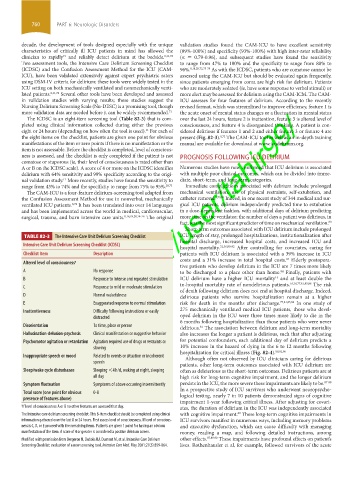
                   The ICDSC is an eight-item screening tool (Table 82-3) that is com-  over the last 24 hours, feature 2 is inattention, feature 3 is altered level of
                 pleted using clinical information collected during either the previous   consciousness, and feature 4 is disorganized thinking. A patient is con-
                 eight or 24 hours (depending on how often the tool is used).  For each of   sidered delirious if features 1 and 2 and either feature 3 or feature 4 are
                                                            11
                 the eight items on the checklist, patients are given one point for obvious   present (Fig. 82-3).  The CAM-ICU tool as well as an in-depth training
                                                                                     8,72
                 manifestations of the item or zero points if there is no manifestation or the   manual are available for download at www.icudelirium.org.
                 item is not assessable. Before the checklist is completed, level of conscious-
                 ness is assessed, and the checklist is only completed if the patient is not   PROGNOSIS FOLLOWING ICU DELIRIUM
                 comatose or stuporous (ie, their level of consciousness is rated other than
                 A or B on the ICDSC scale). A score of 4 or more on the ICDSC identifies   Numerous studies have now confirmed that ICU delirium is associated
                 delirium with 64% sensitivity and 99% specificity according to the origi-  with multiple poor clinical outcomes, which can be divided into imme-
                 nal validation study.  More recently, studies have found the sensitivity to   diate, short-term, and long-term categories.
                               11
                 range from 43% to 74% and the specificity to range from 75% to 95%. 28,73  Immediate complications associated with delirium include prolonged
                   The CAM-ICU is a four-feature delirium-screening tool adapted from   mechanical ventilation, use of physical restraints, self-extubation, and
                 the Confusion Assessment Method for use in nonverbal, mechanically   catheter removal. 9,79,80  Indeed, in one recent study of 344 medical and sur-
                 ventilated ICU patients.  It has been translated into over 14 languages   gical ICU patients, delirium independently predicted time to extubation
                                  8,72
                 and has been implemented across the world in medical, cardiovascular,   in a dose-dependent fashion, with additional days of delirium predicting
                 surgical, trauma, and burn intensive care units. 8,16,18,28,74-76  The original   more time on the ventilator; the number of days a patient was delirious, in
                                                                       fact, was the most significant predictor of time on mechanical ventilation. 80
                                                                         Short-term outcomes associated with ICU delirium include prolonged
                   TABLE 82-3    The Intensive Care Unit Delirium Screening Checklist  ICU length of stay, prolonged hospitalizations,  institutionalization after
                                                                       hospital discharge, increased hospital costs, and increased ICU and
                  Intensive Care Unit Delirium Screening Checklist (ICDSC)
                                                                       hospital  mortality. 32,36,80-82   After  controlling  for  covariates,  caring  for
                  Checklist Item          Description                  patients with ICU delirium is associated with a 39% increase in ICU
                                                                       costs and a 31% increase in total hospital costs.  Elderly postopera-
                                                                                                           83
                  Altered level of consciousness a
                                                                       tive patients who develop delirium in the ICU are 7 times more likely
                  A                       No response                  to  be  discharged  to  a place other  than  home.   Finally,  patients  with
                                                                                                         84
                                                                                                        16
                  B                       Response to intense and repeated stimulation  ICU delirium have a higher ICU mortality  and at least double the
                                                                       in- hospital mortality rate of nondelirious patients. 16,36,77,81,85,86  The risk
                  C                       Response to mild or moderate stimulation
                                                                       of death following delirium does not end at hospital discharge. Indeed,
                  D                       Normal wakefulness           delirious patients who survive hospitalization remain at a higher
                  E                       Exaggerated response to normal stimulation  risk  for  death  in  the  months  after  discharge. 77,81,85,86  In one study of
                  Inattentiveness         Difficulty following instructions or easily   275  mechanically ventilated medical ICU patients, those who devel-
                                          distracted                   oped delirium in the ICU were three times more likely to die in the
                                                                       6 months following hospitalization than those patients who were never
                  Disorientation          To time, place or person     delirious.  The association between delirium and long-term mortality
                                                                              81
                  Hallucination-delusion-psychosis  Clinical manifestation or suggestive behavior  also increases the longer a patient is delirious, such that after adjusting
                  Psychomotor agitation or retardation Agitation required use of drugs or restraints or   for potential confounders, each additional day of delirium predicts a
                                          slowing                      10% increase in the hazard of dying in the 6 to 12 months following
                                                                       hospitalization for critical illness (Fig. 82-4). 80,81,86
                  Inappropriate speech or mood  Related to events or situation or incoherent   Although often not observed by ICU clinicians caring for delirious
                                          speech
                                                                       patients, other long-term outcomes associated with ICU delirium are
                  Sleep/wake cycle disturbance  Sleeping <4 h/d, waking at night, sleeping   often as deleterious as the short-term outcomes. Delirious patients are at
                                          all day                      high risk for long-term cognitive impairment, and the longer delirium
                  Symptom fluctuation     Symptoms of above occurring intermittently  persists in the ICU, the more severe these impairments are likely to be. 87-89
                                                                       In a prospective study of ICU survivors who underwent neuropsycho-
                  Total score (one point for obvious   0-8             logical testing, nearly 7 in 10 patients demonstrated signs of cognitive
                    presence of features above)
                                                                       impairment 1-year following critical illness. After adjusting for covari-
                 a If level of consciousness A or B no other features are assessed that day.  ates, the duration of delirium in the ICU was independently associated
                 The Intensive care delirium screening checklist. This 8-item checklist should be completed using clinical   with cognitive impairment.  These long-term cognitive impairments in
                                                                                           89
                 information gathered over the last 8 or 24 hours. First assess level of consciousness. If level of conscious-  ICU survivors manifest in numerous ways, including memory problems
                 ness is C, D, or E proceed with the remaining items. Patients are given 1 point for having an obvious   and executive dysfunction, which can cause difficulty with managing
                 manifestation of the item. A score of 4 or greater is considered a positive delirium screen.   money, reading a map, and following detailed instructions, among
                 Modified with permission from Bergeron N, Dubois MJ, Dumont M, et al. Intensive Care Delirium   other effects. 87,89,90  These impairments have profound effects on patient’s
                 Screening Checklist: evaluation of a new screening tool. Intensive Care Med. May 2001;27(5):859-864.  lives. Rothenhausler et al, for example, followed survivors of the acute


            section06.indd   760                                                                                       1/23/2015   12:55:27 PM

