


Page 1120 - Hall et al (2015) Principles of Critical Care-McGraw-Hill
P. 1120
CHAPTER 82: Delirium in the Intensive Care Unit  759


                                                                                   Medications
                                                   Medications                     Medical illness
                                                   Alcohol withdrawal
                                   Medications                                     Surgical illness
                                   Stroke
                                                                                                 Benzodiazepine and
                                                        Cholinergic   Cholinergic                alcohol withdrawal
                                                        activation    inhibition
                                             Dopamine                              Reduced
                                             activation                            GABA activity
                                  https://kat.cr/user/tahir99/
                                         Cytokine                                    GABA         Benzodiazepines
                                         excess
                                                                                     activation   Hepatic failure
                                              Serotonin             Delirium
                                              activation
                                                                                     Glutamate
                                                                                     activation
                                                          Serotonin        Cortisol
                                                          deficiency
                                                                           excess
                                  Medications
                                  substance withdrawal  Tryptophan depletion                      Hepatic failure
                                                      Phenyalanine elevation                      Alcohol withdrawal
                                                                                  Glucocorticoids
                                                                                  Cushings syndrome
                                                        Surgical illness          Surgery
                                                        Medical illness           Stroke
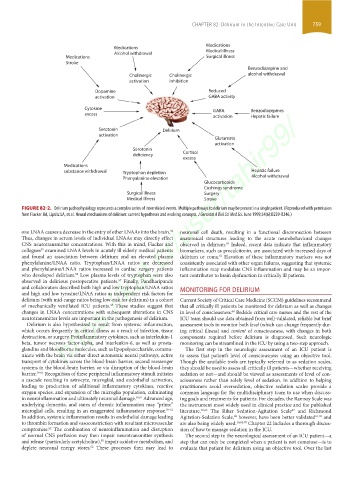
                    FIGURE 82-2.  Delirium pathophysiology represents a complex series of interrelated events. Multiple pathways to delirium may be present in a single patient. (Reproduced with permission
                    from Flacker JM, Lipsitz LA, et al. Neural mechanisms of delirium: current hypotheses and evolving concepts. J Gerontol A Biol Sci Med Sci. June 1999;54(6):B239-B246.)

                    one LNAA causes a decrease in the entry of other LNAAs into the brain.    neuronal cell death, resulting in a functional disconnection between
                                                                      52
                    Thus, changes in serum levels of individual LNAAs may directly effect     anatomical structures leading to the acute neurobehavioral changes
                    CNS neurotransmitter concentrations. With this in mind, Flacker and   observed in   delirium.  Indeed, recent data indicate that inflammatory
                                                                                         59
                          55
                    collegues  examined LNAA levels in acutely ill elderly medical patients   biomarkers, such as procalcitonin, are associated with increased days of
                    and found an association between delirium and an elevated plasma   delirium or coma.  Elevation of these inflammatory markers was not
                                                                                       63
                    phenylalanine/LNAA ratio. Tryptophan/LNAA ratios are decreased   consistently associated with other organ failures, suggesting that systemic
                    and phenylalanine/LNAA ratios increased in cardiac surgery patients   inflammation may modulate CNS inflammation and may be an impor-
                                      56
                    who developed delirium.  Low plasma levels of tryptophan were also   tant  contributor to brain dysfunction in critically ill patients.
                    observed in delirious postoperative patients.  Finally, Pandharipande
                                                     57
                    and collaborators described both high and low tryptophan/LNAA ratios   MONITORING FOR DELIRIUM
                    and high and low tyrosine/LNAA ratios as independent risk factors for
                    delirium (with mid-range ratios being low-risk for delirium) in a cohort   Current Society of Critical Care Medicine (SCCM) guidelines recommend
                    of mechanically ventilated ICU patients.  These studies suggest that   that all critically ill patients be monitored for delirium as well as changes
                                                  58
                    changes in LNAA concentrations with subsequent alterations in CNS   in level of consciousness.  Bedside critical care nurses and the rest of the
                                                                                           64
                    neurotransmitter levels are important in the pathogenesis of delirium.  ICU team should use data obtained from well-validated, reliable but brief
                     Delirium is also hypothesized to result from systemic inflammation,   assessment tools to monitor both level (which can change frequently dur-
                    which occurs frequently in critical illness as a result of infection, tissue   ing critical illness) and  content of consciousness, with changes in both
                    destruction, or surgery. Proinflammatory cytokines, such as  interleukin-1   components  required  before  delirium  is  diagnosed.  Such  neurologic
                    beta, tumor necrosis factor-alpha, and interleukin-6, as  well as prosta-  monitoring can be streamlined in the ICU by using a two-step approach.
                    glandins and bloodborne molecules, such as lipopolysaccharide, commu-  The first step in the neurologic assessment of an ICU patient is
                    nicate with the brain via either direct autonomic neural pathways, active   to assess that patient’s level of consciousness using an objective tool.
                    transport of cytokines across the blood-brain barrier, second messenger   Though the available tools are typically referred to as sedation scales,
                    systems in the blood-brain barrier, or via disruption of the blood-brain   they should be used to assess all critically ill patients—whether receiving
                    barrier. 59-61  Recognition of these peripheral inflammatory stimuli initiates   sedation or not—and should be viewed as assessments of level of con-
                    a cascade resulting in astrocyte, microglial, and   endothelial   activation,   sciousness rather than solely level of sedation. In addition to helping
                    leading to production of additional inflammatory cytokines, reactive   practitioners avoid oversedation, objective sedation scales provide a
                      oxygen species, and expansion of the microglia population, culminating   common language for the multidisciplinary team to use when discuss-
                    in neuroinflammation and ultimately neuronal damage. 59,61  Advanced age,   ing goals and treatments for patients. For decades, the Ramsay Scale was
                    underlying dementia, and states of chronic inflammation may “prime”   the instrument most widely used in clinical practice and the published
                    microglial cells, resulting in an exaggerated inflammatory response. 59-61    literature. 65,66  The Riker Sedation-Agitation Scale  and Richmond
                                                                                                                67
                    In addition, systemic inflammation results in endothelial damage leading   Agitation-Sedation Scale,  however, have been better validated 67,69  and
                                                                                            68
                    to thrombin formation and vasoconstriction with resultant microvascular   are also being widely used. 16,66,70  Chapter 22 includes a thorough discus-
                    compromise.  The combination of neuroinflammation and disruption   sion of how to manage sedation in the ICU.
                             62
                    of normal CNS perfusion may then impair neurotransmitter synthesis   The second step in the neurological assessment of an ICU patient—a
                    and release (particularly  acetylcholine),  impair oxidative metabolism, and   step that can only be completed when a patient is not comatose—is to
                                               50
                                           52
                    deplete neuronal energy stores.  These processes then may lead to   evaluate that patient for delirium using an objective tool. Over the last


            section06.indd   759                                                                                       1/23/2015   12:55:27 PM

