


Page 1128 - Hall et al (2015) Principles of Critical Care-McGraw-Hill
P. 1128
CHAPTER 83: ICU-Acquired Weakness  767


                                                           Critically ill patient exhibits weakness
                                                                    or inactivity

                                                             Awake and able to participate in
                                                            neuromuscular exam (MRC exam)?
                                                  No                                       Yes


                                                                         Asymmetric     ICUAW       Not weak
                                                                          weakness
                                                 EP Studies
                                                  EMG, NCS                            Observation
                                           Repetitive nerve stimulation
                                                                                Fails to          Gradual
                                                                               improve          improvement
                                                     Prolonged     Other
                                         CIP, CIM
                                                   NMJ blockade   diagnosis
                                                                                                 No further
                                                                                                  testing
                                        Confirmatory
                                        test needed?


                                        DMS, muscle
                                          biopsy

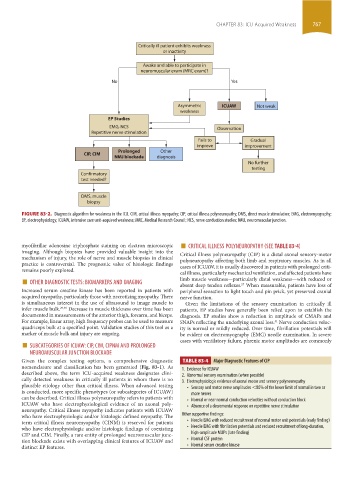
                    FIGURE 83-2.  Diagnostic algorithm for weakness in the ICU. CIM, critical illness myopathy; CIP, critical illness polyneuropathy; DMS, direct muscle stimulation; EMG, electromyography;
                    EP, electrophysiology; ICUAW, intensive care unit-acquired weakness; MRC, Medical Research Council; NCS, nerve conduction studies; NMJ, neuromuscular junction.

                                                                              ■
                    myofibrillar adenosine triphosphate staining on electron microscopic   CRITICAL ILLNESS POLYNEUROPATHY (SEE TABlE 83-4)
                    imaging. Although biopsies have provided valuable insight into the   Critical illness polyneuropathy (CIP) is a distal axonal sensory-motor
                    mechanism of injury, the role of nerve and muscle biopsies in clinical   polyneuropathy affecting both limb and respiratory muscles. As in all
                    practice is controversial. The prognostic value of histologic findings   cases of ICUAW, it is usually discovered in patients with prolonged criti-
                    remains poorly explored.                              cal illness, particularly mechanical ventilation, and affected patients have
                        ■  OTHER DIAGNOSTIC TESTS: BIOMARKERS AND IMAGING  limb muscle weakness—particularly distal weakness—with reduced or

                                                                                              27
                    Increased serum  creatine  kinase  has been  reported  in patients with   absent deep tendon reflexes.  When measurable, patients have loss of
                                                                          peripheral sensation to light touch and pin prick, yet preserved cranial
                    acquired myopathy, particularly those with necrotizing myopathy. There   nerve function.
                    is simultaneous interest in the use of ultrasound to image muscle to   Given the limitations of the sensory examination in critically ill
                    infer muscle bulk. 29,30  Decrease in muscle thickness over time has been   patients, EP studies have generally been relied upon to establish the
                    documented in measurements of the anterior thigh, forearm, and biceps.   diagnosis. EP studies show a reduction in amplitude of CMAPs and
                    For example, linear array, high frequency probes can be used to measure   SNAPs reflecting the underlying axonal loss.  Nerve conduction veloc-
                                                                                                          31
                    quadriceps bulk at a specified point. Validation studies of this tool as a   ity is normal or mildly reduced. Over time, fibrillation potentials will
                    marker of muscle bulk and injury are ongoing.         be evident on electromyography (EMG) needle examination. In severe
                        ■  SUBCATEGORIES OF ICUAW: CIP, CIM, CIPNM AND PROLONGED   cases with ventilatory failure, phrenic motor amplitudes are commonly

                      NEUROMUSCULAR JUNCTION BLOCKADE
                    Given the complex testing options, a comprehensive diagnostic     TABLE 83-4    Major Diagnostic Features of CIP
                    nomenclature and classification has been generated (Fig. 83-1). As   1.  Evidence for ICUAW
                    described above, the term ICU-acquired weakness designates clini-  2.  Abnormal sensory examination (when possible)
                    cally detected weakness in critically ill patients in whom there is no   3.  Electrophysiologic evidence of axonal motor and sensory polyneuropathy
                    plausible etiology other than critical illness. When advanced testing   •  Sensory and motor nerve amplitudes <80% of the lower limit of normal in two or
                    is conducted, more specific phenotypes (or subcategories of ICUAW)   more nerves
                    can be described. Critical illness polyneuropathy refers to patients with   •  Normal or near normal conduction velocities without conduction block
                    ICUAW  who  have  electrophysiological  evidence  of  an  axonal  poly-  •  Absence of a decremental response on repetitive nerve stimulation
                    neuropathy. Critical illness myopathy indicates patients with ICUAW
                    who have electrophysiologic and/or histologic defined myopathy. The   Other supportive findings:
                    term critical illness neuromyopathy (CINM) is reserved for patients   •  Needle EMG with reduced recruitment of normal motor unit potentials (early finding)
                    who have electrophysiologic and/or histologic findings of coexisting   •  Needle EMG with fibrillation potentials and reduced recruitment of long-duration,
                    CIP and CIM. Finally, a rare entity of prolonged neuromuscular junc-  high-amplitude MUPs (late finding)
                    tion blockade exists with overlapping clinical features of ICUAW and   •  Normal CSF protein
                    distinct EP features.                                   •  Normal serum creatine kinase


            section06.indd   767                                                                                       1/23/2015   12:55:31 PM

