


Page 1125 - Hall et al (2015) Principles of Critical Care-McGraw-Hill
P. 1125
764     PART 6: Neurologic Disorders


                                                                       One widely cited catalyst for attention to the burden of neuromuscular
                    is unable to participate in a comprehensive neuromuscular examina-  weakness was the comprehensive observations of a cohort of survivors
                    tion, is failing to improve function despite weeks of therapy, or for the   of acute respiratory distress syndrome (ARDS) published in 2003.
                                                                                                                          12
                    patient with asymmetric weakness.                  These 109 survivors were young (median age, 45 years), had few pre-
                     • When conducted, advanced testing, particularly electrophysiology tests,   existing comorbidities, and were severely ill (median APACHE II
                    can characterize the specific phenotype of ICU-AW including critical   score, 23). Their critical illness was marked by prolonged mechanical
                      illness polyneuropathy, critical illness myopathy, a combination of the   ventilation (median duration, 21 days) and ICU and hospital lengths
                    two (polyneuromyopathy), or prolonged neuromuscular blockade.  of stay (median duration, 25 and 48 days, respectively). Despite severe
                     • The exact epidemiology of ICUAW is unknown. Studies show that   acute  lung  injury,  serial  follow-up  examination  during  the  first  year
                                                                       after ICU discharge demonstrated restoration of lung function. Lung
                    46% of patients with sepsis, multiorgan failure, or prolonged mechan-  volumes and spirometry normalized by 6 months and carbon monoxide
                                https://kat.cr/user/tahir99/
                    ical  ventilation are diagnosed with ICUAW. In patients undergoing   diffusion capacity improved to 72% predicted at 12 months. In contrast,
                    mechanical ventilation for 7 days or more, 25% develop ICUAW.  all 109 patients reported poor function attributed to the loss of muscle
                     • Factors associated with the diagnosis of ICUAW include the presence   bulk, proximal weakness, and fatigue. One year after ICU discharge, the
                    of multisystem organ dysfunction, sepsis, SIRS, and hyperglycemia   median distance walked in 6 minutes was 66% of predicted and only
                    and the duration of mechanical ventilation. The only known therapy   49% of patients had returned to work.
                    to prevent ICUAW has been strict glycemic control with insulin; how-  More recently, the same cohort was characterized at 5 years after ICU
                    ever, adverse events with this therapy have prevented its utilization.  discharge.  All patients reported subjective weakness and decreased
                                                                              13
                                                                       exercise capacity when compared to function before ICU admission.
                                                                       Although there was no evidence of clinical weakness on examination,
                                                                       the median distance walked in 6 minutes remained lower than expected
                 INTRODUCTION                                          based on age and sex (76% predicted). By the fifth year, 77% of patients
                                                                       had returned to work; however, patients often required a modified
                 Many patients admitted to the intensive care unit (ICU) develop a syn-  work schedule, gradual transition back to work, or job retraining. In
                 drome of neuromuscular dysfunction characterized by generalized muscle   addition, patients were plagued with the psychological ramifications of
                 weakness and an inability to be liberated from mechanical ventilation.   their severe illness; more than half of survivors experienced at least one
                 Since this syndrome occurs in the absence of preexisting neuromuscular   episode of physician-confirmed depression or anxiety.
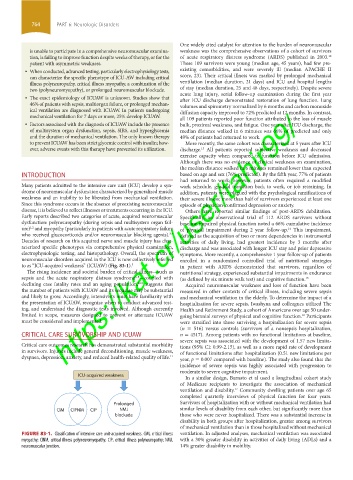
                 disease, it is believed to reflect illnesses or treatments occurring in the ICU.   Others  have reported similar findings  of post-ARDS  debilitation.
                 Early reports described two categories of acute, acquired neuromuscular   Specifically, an observational trial of 112 ARDS survivors without
                 dysfunction: polyneuropathy (during sepsis and multisystem organ fail-  baseline impaired physical function noted a 66% cumulative incidence
                 ure)  and myopathy (particularly in patients with acute respiratory failure   of physical impairment during 2 year follow-up.  This impairment,
                    1,2
                                                                                                            14
                 who received glucocorticoids and/or neuromuscular blocking agents).    defined as the acquisition of two or more dependencies in instrumental
                                                                    3,4
                 Decades of research on this acquired nerve and muscle injury has char-  activities of daily living, had greatest incidence by 3 months after
                 acterized specific phenotypes via comprehensive physical examination,   discharge and was associated with longer ICU stay and prior depressive
                 electrophysiologic testing, and histopathology. Overall, the spectrum of   symptoms. More recently, a comprehensive 1 year follow-up of patients
                 neuromuscular disorders acquired in the ICU is now collectively referred   enrolled in a randomized controlled trial of nutritional strategies
                 to as “ICU-acquired weakness” (ICUAW) (Fig. 83-1). 5  in patient with ARDS demonstrated that survivors, regardless of
                   The rising incidence and societal burden of critical illness—such as   nutritional strategy, experienced substantial impairments in endurance
                 sepsis and the acute respiratory distress syndrome —coupled with   (as defined by six minute walk test) and cognitive function. 15
                                                        6-8
                 declining case fatality rates and an aging population,  suggests that   Acquired neuromuscular weakness and loss of function have been
                                                         9,10
                 the number of patients with ICUAW and its sequelae may be substantial   measured in other contexts of critical illness, including severe sepsis
                 and likely to grow. Accordingly, intensivists must have familiarity with   and mechanical ventilation in the elderly. To determine the impact of a
                 the presentation of ICUAW, recognize when to conduct advanced test-  hospitalization for severe sepsis, Iwashyna and colleagues utilized The
                 ing, and understand the diagnostic tests involved. Although currently   Health and Retirement Study, a cohort of Americans over age 50 under-
                   limited in scope, measures designed to prevent or attenuate ICUAW   going biennial surveys of physical and cognitive function.  Participants
                                                                                                                 16
                 must be considered and implemented.                   were stratified into those surviving a hospitalization for severe sepsis
                                                                       (n  = 516) versus controls (survivors of a nonsepsis hospitalization,
                 CRITICAL CARE SURVIVORSHIP AND ICUAW                  n = 4517). Among patients with no functional limitations at baseline,
                                                                       severe sepsis was associated with the development of 1.57 new limita-
                 Critical care outcomes research has demonstrated substantial morbidity   tions (95% CI: 0.99-2.15), as well as a more rapid rate of development
                 in survivors. Injuries include general deconditioning, muscle weakness,   of functional limitations after hospitalization (0.51 new limitations per
                 dyspnea, depression, anxiety, and reduced health-related quality of life.    year, p = 0.007 compared with baseline). The study also found that the
                                                                    11
                                                                       incidence of severe sepsis was highly associated with progression to
                                                                       moderate to severe cognitive impairment.
                                     ICU-acquired weakness               In a similar design, Barnato et al used a longitudinal cohort study
                                                                       of  Medicare  recipients  to  investigate  the  association  of  mechanical
                                                                       ventilation and disability.  Community dwelling patients over age 65
                                                                                          17
                                                                       completed quarterly interviews of physical function for four years.
                                                 Prolonged             Survivors of hospitalization with or without mechanical ventilation had
                             CIM  CIPNM  CIP       NMJ                 similar levels of disability from each other, but significantly more than
                                                 blockade              those who were never hospitalized. There was a substantial increase in
                                                                       disability in both groups after hospitalization, greater among survivors
                                                                       of mechanical ventilation than in those hospitalized without mechanical
                 FIGURE 83-1.  Classification of intensive care unit-acquired weakness. CIM, critical illness   ventilation. In adjusted analyses, mechanical ventilation was associated
                 myopathy; CINM, critical illness polyneuromyopathy; CIP, critical illness polyneuropathy; NMJ,   with a 30% greater disability in activities of daily living (ADLs) and a
                 neuromuscular junction.                               14% greater disability in mobility.


            section06.indd   764                                                                                       1/23/2015   12:55:29 PM

