


Page 1129 - Hall et al (2015) Principles of Critical Care-McGraw-Hill
P. 1129
768     PART 6: Neurologic Disorders


                 reduced or absent. In patients with CIP, direct needle stimulation of   are short in duration, low in amplitude, and may be polyphasic.  In
                                                                                                                        40
                 muscle elicits a relatively higher amplitude response compared with the   contrast, long-duration, polyphasic, high amplitude MUPs may suggest
                 response recorded from muscle after nerve stimulation.  neuropathy.
                   The serum CK level is normal, and, when performed, cerebrospinal   Direct muscle stimulation can be conducted to assess for electrical
                 fluid protein levels are usually normal. Muscle biopsy findings are those   inexcitability and may help to differentiate CIM from motor axonopa-
                 of neurogenic atrophy. Nerve histology in patients with electrophysi-  thy.  However, this modality is often limited to those patients with a
                                                                          26
                 ologic-defined CIP demonstrates distal axonal degeneration involving   coexisting peripheral neuropathy.
                 both sensory and motor fibers with no evidence of demyelination or   Alternatively, CIM may be established with muscle biopsy. The major
                 inflammation.                                         histopathologic finding is the selective loss of myosin, identified as a
                   Prior investigations have commonly associated CIP with severe   lack of reactivity to myosin ATPase in non-necrotic fibers. This finding
                 sepsis and experts suspect it represents a neurologic manifestation of   can be confirmed with immunohistochemic studies for myosin and by
                 the systemic inflammatory response syndrome (SIRS). 28,32,33  There is   utilizing electron microscopy to identify loss of thick filaments. There
                 some  correlation  with  elevations  in  blood  glucose  and  reductions  in   is usually atrophy of myofibers (type 2 more than type 1), evidence of
                 serum albumin.  The mechanism of axonal injury in CIP is unknown.   myofibrillar disorganization, and occasional necrosis. 41,42
                             34
                 However, injury to the microcirculation of distal nerves, causing isch-  Several processes may be involved in the pathogenesis of CIM, includ-
                 emia and axonal degeneration, is speculated. 33,35  During the early stages   ing upregulation of calpain, an increase in muscle apoptosis, activation
                 of sepsis, electrical inexcitability due to sodium channel inactivation   of the proteasome ubiquitin-degradative system, and upregulation of
                 may be present in otherwise intact nerves.            the transforming growth factor-beta/mitogen-activated protein kinase
                     ■  CRITICAL ILLNESS MYOPATHY (SEE TABlE 83-5)     pathway.  Oxidative stress may also play a role. Observation of the loss
                                                                             43
                                                                       of sarcolemmal nitric oxide synthase isoform 1 may lead to muscle fiber
                 The most common form of intensive care unit (ICU)-acquired myopa-  inexcitability. 44
                 thy is critical illness myopathy (CIM).  The most common presenting   A steroid-denervation animal model reproduces the histopathologic
                                             36
                                                                                                                      45
                 features of CIM are flaccid quadriparesis that may have a different pat-  and electrophysiologic findings of CIM observed in humans.  This
                 tern than CIP. Whereas CIP exhibits a length-related pattern (ie, distal   model suggests that a deleterious interaction between glucocorticoids
                 muscles are weakest), CIM usually affects proximal muscles either   and denervation leads to depletion of the mRNA for myosin and results
                                                                                     46
                 equally or more pronounced than distal muscles. Facial muscle weak-  in  muscle  atrophy.   Finally,  muscle  sodium  channel properties  have
                 ness can occur, but extraocular muscle weakness is rare. Like other   also been implicated using a chronic sepsis animal model. Patch clamp
                 entities, patients often repeatedly fail to wean from mechanical ventila-  technique revealed decreased sodium current that could lead to muscle
                 tion. Although not always assessable, sensation should be normal. For   inexcitability. 47
                 example, these patients often grimace to painful stimuli even during     ■
                 periods of delirium.                                     CRITICAL ILLNESS POLYNEUROMYOPATHY
                   In retrospective series of patients with CIM, approximately one-half   More recent investigations have proven that a reasonable proportion of
                 had elevations in CK.  In patients with appropriate clinical features, the   patients have features of combined CIM and CIP, termed critical illness
                                 37
                                                                                      48
                 diagnosis of CIM can be confirmed by electrophysiologic testing with   polyneuromyopathy.  The commonality of this entity was illustrated by
                 nerve conduction studies (NCS) and electromyography (EMG). Muscle   a prospective longitudinal cohort study of 48 patients who had baseline
                 biopsy establishes the diagnosis, but is rarely performed unless another   neurologic examinations and nerve conduction studies (NCS) within
                 treatable condition, such as an inflammatory myopathy, is in the dif-  72 hours of developing severe sepsis.  Electromyography was performed
                                                                                                 49
                 ferential diagnosis.                                  on patients who developed clinical weakness or had 30% or greater
                   The major nerve conduction findings of CIM are normal to low   reduction in nerve conduction response amplitudes. Clinical and elec-
                 motor amplitudes with occasional broadening of the CMAP. 38,39  Phrenic   trophysiologic examinations were repeated weekly for the duration of
                 motor amplitudes may also be low. Sensory responses are normal or   the ICU stay. Abnormal NCS were present at baseline in 63% of patients,
                 only mildly reduced, unless there is a coexisting polyneuropathy. Needle   and an abnormality on baseline NCS was significantly associated with
                 examination frequently demonstrates fibrillation potential activity   hospital mortality compared with a normal baseline NCS (55% vs 0%,
                 implicating recent denervation or muscle necrosis.  Observation of the   respectively). In 20 patients who remained in the ICU long enough to
                                                      31
                 recruitment of motor unit potentials (MUPs) may not be possible in   have serial NCS, neuromuscular dysfunction developed in 10 patients
                 advanced weakness. When feasible, recruitment tends to be early. MUPs   (50%). Electrophysiologic evidence of both CIM and CIP was present
                                                                       in 8 of 10 patients with neuromuscular dysfunction. The investigators
                                                                       hypothesized that sepsis may be a common pathologic mechanism
                                                                       underlying the development of both CIM and CIP.
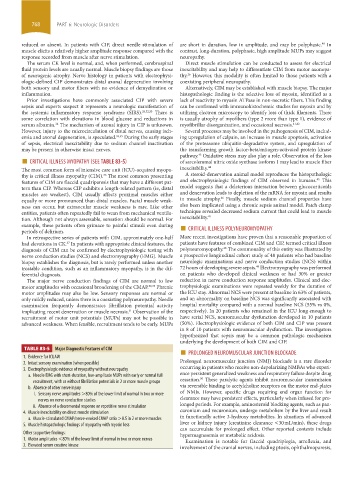
                   TABLE 83-5    Major Diagnostic Features of CIM          ■  PROLONGED NEUROMUSCULAR JUNCTION BLOCKADE
                  1.  Evidence for ICUAW
                  2.  Intact sensory examination (when possible)       Prolonged neuromuscular junction (NMJ) blockade is a rare disorder
                  3.  Electrophysiologic evidence of myopathy without neuropathy  occurring in patients who receive non-depolarizing NMBAs who experi-
                    a.   Needle EMG with short-duration, low-amplitude MUPs with early or normal full   ence persistent generalized weakness and respiratory failure despite drug
                                                                              50
                       recruitment, with or without fibrillation potentials in 2 or more muscle groups  cessation.  These paralytic agents inhibit neuromuscular transmission
                    b.  Absence of other nerve injury                  via reversible binding to acetylcholine receptors on the motor end-plates
                     i.   Sensory nerve amplitudes >80% of the lower limit of normal in two or more   of NMJs. However, specific drugs   requiring end organ function for
                       nerves on nerve conduction studies              clearance may have persistent effects, particularly when infused for pro-
                     ii.  Absence of a decremental response on repetitive nerve stimulation  longed periods. For example, aminosteroid blocking agents, such as pan-
                  4.  Muscle inexcitability on direct muscle stimulation  curonium and vecuronium, undergo metabolism by the liver and result
                    a.  Muscle-stimulated CMAP/nerve-evoked CMAP ratio >0.5 in 2 or more muscles  in functionally active 3-hydroxy metabolites. In situations of advanced
                  5.  Muscle histopathologic findings of myopathy with myosin loss  liver or kidney injury ( creatinine clearance <30 mL/min), these drugs
                                                                       can accumulate for prolonged effect. Other reported contexts include
                  Other supportive findings:                           hypermagnesemia or metabolic acidosis.
                  1.  Motor amplitudes <80% of the lower limit of normal in two or more nerves  Examination  is notable for flaccid quadriplegia, arreflexia, and
                  2.  Elevated serum creatine kinase                   involvement of the cranial nerves, including ptosis, ophthalmoparesis,


            section06.indd   768                                                                                       1/23/2015   12:55:31 PM

