


Page 1166 - Hall et al (2015) Principles of Critical Care-McGraw-Hill
P. 1166
CHAPTER 86: Intracranial Pressure: Monitoring and Management  805


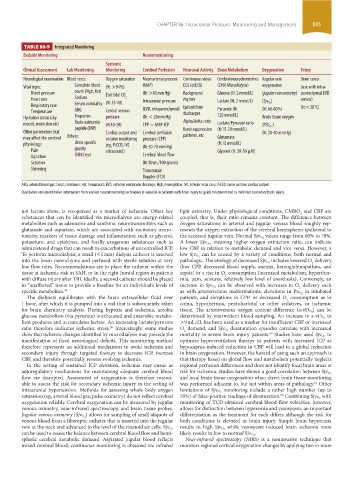
                      TABLE 86-9    Integrated Monitoring
                    Bedside Monitoring                       Neuromonitoring
                                                Systemic
                    Clinical Assessment  lab Monitoring  Monitoring  Cerebral Perfusion  Neuronal Activity Brain Metabolism  Oxygenation  Temp
                    Neurological examination Blood tests:  Oxygen saturation  Mean arterial pressure  Continuous video  Cerebral neurochemistries  Jugular vein   Brain temp
                    Vital signs:      Complete blood   (N: >94%)  (MAP)    EEG (cvEEG)  (CMA Microdialysis)    oxygenation  (use with intra-
                       Blood pressure  count (Hgb, Hct)  End tidal CO  (N: >80 mm Hg)  Background   Glucose (N: 2 mmol/L)  (jugular vein oximetry) parenchymal EVD
                       Heart rate     Sodium           2     Intracranial pressure  rhythm  Lactate (N: 2 mmol/L)  )  sensor)
                       Respiratory rate  Serum  osmolality (N: 35-40)      Epileptiform               (Sjv O 2     (N:<38 °C)
                       Temperature    ABG       Central venous   (EVD,  intraparenchymal)    discharges  Pyruvate (N:   (N: 60-80%)
                    Hydration status (dry   Troponins    pressure  (N: < 20 mm Hg)    120 mmol/L)     Brain tissue oxygen
                    mouth, moist skin etc)  Brain-natriuretic   (N:10-20)  CPP = MAP-ICP  Alpha/delta ratio  Lactate/Pyruvate ratio    )
                                      peptide (BNP)                        Burst suppression  (N:15-20 mmol/L)  (PBt O 2
                    Other parameters that       Cardiac output and   Cerebral perfusion               (N: 20-40 mm Hg)
                    may affect the cerebral   Others:  volume  monitoring  pressure (CPP)  patterns, etc  Glutamate
                    physiology:       Urine specific   (eg, PiCCO, IVC   (N: 50-70 mm Hg)  (N:10 mmol/L)
                       Pain           gravity     ultrasound)                         Glycerol (N: 20-50 µM)
                       Agitation      BUN:Creat              Cerebral blood flow
                       Sedation                              (N: 50 mL/100 g/min)
                       Shivering                             Transcranial
                                                             Doppler (TCD)
                    ABG, arterial blood gas; Creat, creatinine; Hct, hematocrit; EVD, external ventricular drainage; Hgb, hemoglobin; IVC, inferior vena cava; PiCCO, pulse contour cardiac output.
                    Qualitative and quantitative information from various neuromonitoring techniques is valuable in patients with brain injury to guide treatment and to minimize secondary brain injury.


                    not  lactate  alone,  is  recognized  as  a  marker  of  ischemia.  Other  key   light oximetry. Under physiological conditions, CMRO  and CBF are
                                                                                                                   2
                    substances  that  can  be  identified  via  microdialysis  are  energy-related   coupled, that is, their ratio remains constant. The difference between
                    metabolites such as adenosine and xanthine, neurotransmitters such as   oxygen saturations in arterial and jugular venous blood roughly rep-
                    glutamate and aspartate, which are associated with excitatory neuro-  resents the oxygen extraction of the cerebral hemispheres ipsilateral to
                    toxicity, markers of tissue damage and inflammation such as glycerol,   the accessed jugular vein. Normal Sjv O 2  values range from 60% to 70%.
                    potassium, and cytokines, and finally exogenous substances such as   A lower Sjv O 2 , meaning higher oxygen extraction ratio, can indicate
                    administered drugs that can result in exacerbations of uncontrolled ICP.   low CBF in relation to metabolic demand and vice versa. However, a
                    To perform microdialysis, a small (<1 mm) dialysis catheter is inserted   low Sjv O 2  can be caused by a variety of conditions, both normal and
                    into the brain parenchyma and perfused with sterile solution at very   pathologic. The etiology of decreased Sjv O 2  includes lowered O  delivery
                                                                                                                       2
                    low flow rates. Recommendations are to place the catheter within the   (low CPP, decreased blood supply, anemia, hemoglobinopathies, and
                    tissue at ischemic risk in SAH, or in the right frontal region in patients   sepsis) or a rise in O  consumption (increased metabolism, hyperther-
                                                                                         2
                    with diffuse injury after TBI. Ideally, a second catheter should be placed   mia, pain, seizures, relatively low level of anesthesia). Conversely, an
                    in “unaffected” tissue to provide a baseline for an individual’s levels of   increase in Sjv O 2  can be observed with increases in O  delivery such
                                                                                                                  2
                    specific metabolites. 58                              as with arteriovenous malformations, elevations in  Pa O 2   in intubated
                     The dialysate equilibrates with the brain extracellular fluid over   patients, and elevations in CPP, or decreased O  consumption as in
                                                                                                              2
                    1 hour, after which it is pumped into a vial that is subsequently taken   coma, hypothermia, pentobarbital or other sedatives, or ischemic
                    for brain chemistry analysis. During hypoxia and ischemia, aerobic     tissue. The arteriovenous oxygen content difference (a-vD O 2 ) can be
                    glucose metabolism (via pyruvate) is exhausted and anaerobic metabo-  determined by intermittent blood sampling. An increase in a-vD O 2  to
                    lism produces and accumulates lactate. An increasing lactate/pyruvate   >9 mL/dL has been used as a marker for insufficient CBF or increased
                    ratio therefore indicates ischemic stress.  Interestingly, some studies   O   demand,  and  Sjv O 2   desaturation  episodes  correlate  with  increased
                                                  59
                                                                           2
                    show that ischemic changes identified by microdialysis may precede the   mortality in severe brain injury patients.  Studies have used Sjv O 2  to
                                                                                                        60
                    manifestation of fixed neurological deficits. This monitoring method   optimize hyperventilation therapy in patients with increased ICP as
                    therefore represents an additional mechanism  to avoid ischemia and   hypocapnia-induced reduction in CBF will lead to a global reduction
                    secondary injury through targeted therapy to decrease ICP, increase   in brain oxygenation. However, the hazard of using such an approach is
                    CBF, and therefore potentially reverse evolving ischemia.  that therapy based on global flow and metabolism potentially neglects
                     In the setting of sustained ICP elevation, ischemia may ensue as   regional perfusion differences and does not identify focal brain areas at
                    autoregulatory mechanisms for maintaining adequate cerebral blood   risk for ischemia. Studies have shown a good correlation between Sjv O 2
                    flow  are  disrupted.  Assessment  of  oxygenation  is  therefore  reason-  and local brain tissue oxygenation when direct brain tissue monitoring
                    able to assess the risk for secondary ischemic injury in the setting of   was performed adjacent to, but not within areas of pathology.  Other
                                                                                                                       61
                    intracranial hypertension. Methods for assessing whole body oxygen   limitations of Sjv O 2  monitoring include a rather high number (up to
                    saturation (eg, arterial blood gas, pulse oximetry) do not reflect cerebral   50%) of false-positive readings of desaturation.  Combining Sjv O 2  with
                                                                                                            62
                    oxygenation reliably. Cerebral oxygenation can be measured by jugular   monitoring of TCD-obtained cerebral blood flow velocities, however,
                    venous oximetry, near-infrared spectroscopy, and brain tissue probes.   allows for distinction between hyperemia and vasospasm, an important
                                         ) allows for sampling of small aliquots of   differentiation as the treatment for each differs although the risk for
                    Jugular venous oximetry (Sjv O 2
                    venous blood from a fiberoptic catheter that is inserted into the jugular   both conditions is elevated in brain injury. Simple brain hyperemia
                                                                                          while vasospasm-induced brain ischemia more
                    vein at the neck and advanced to the level of the mastoid air cells. Sjv O 2  results in high Sjv O 2
                    can be used to assess the balance between cerebral blood flow and hemi-  likely results in low to normal Sjv O 2 .
                    spheric cerebral metabolic demand. Aspirated jugular blood reflects   Near-infrared spectroscopy (NIRS) is a noninvasive technique that
                    mixed cerebral blood; continuous monitoring is obtained via infrared   monitors regional cortical oxygenation changes by applying two or more


            section06.indd   805                                                                                       1/23/2015   12:56:05 PM

