


Page 1161 - Hall et al (2015) Principles of Critical Care-McGraw-Hill
P. 1161
800     PART 6: Neurologic Disorders


                 disc. Paton lines, defined as circumferential peripapillary retinal folds
                 caused by inward buckling of the swollen disc, are another manifestation
                 of optic nerve edema secondary to raised ICP.
                   In general, pupillary dilation is seen as a result of third nerve compres-
                 sion identified by pupillary dilation with ptosis, sparing abduction, and
                 intorsion-depression. A third cranial nerve palsy can be seen as a result
                 of a variety of intracranial processes, including uncal herniation in which   Decorticate or flexor posturing
                 the nerve is compressed against the tentorium. It can also be seen in the
                 absence of intracranial hypertension as with aneurysms of the posterior
                 communicating artery that directly impinge on the nerve (Fig. 86-1B).
                 In  this  case,  however,  the  patient  does  not  exhibit  additional  signs  of
                 raised ICP such as altered sensorium, lethargy, nausea, or vomiting.
                 Conditions that exert mass effect on or produce shearing injury to the
                 midbrain structures harboring the third nerve nucleus, such as tumors
                 and trauma, may also produce third nerve palsies without elevated ICP.  Decerebrate or extensor posturing
                   Sixth nerve palsies are also seen with elevated ICP as this nerve
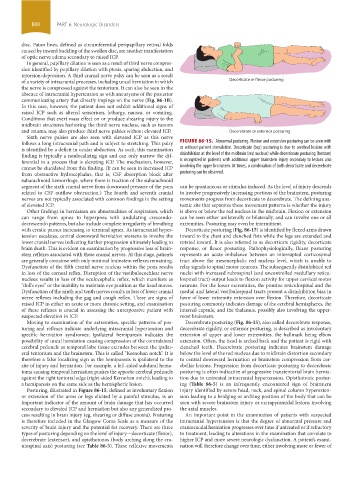
                   follows a long intracranial path and is subject to stretching. This palsy   FIGURE 86-15.  Abnormal posturing. Flexion and extension posturing can be seen with
                 is identified by a deficit in ocular abduction. As such, this examination   or without patient stimulation. Decorticate (top) posturing is due to cerebral lesions with
                 finding is typically a nonlocalizing sign and can only narrow the dif-  disinhibition at the level of the midbrain (red nucleus) while decerebrate posturing (bottom)
                 ferential to a process that is elevating ICP. The mechanism, however,   is recognized in patients with additional upper brainstem injury secondary to lesions also
                 cannot be elucidated from this finding. (It can be seen in increased ICP   involving the upper brainstem. At times, a combination of both decorticate and decerebrate
                 from obstructive hydrocephalus, that is, CSF absorption block after   posturing can be observed.
                 subarachnoid hemorrhage, where there is traction of the subarachnoid
                 segment of the sixth cranial nerve from downward pressure of the pons   can be spontaneous or stimulus induced. As the level of injury descends
                 related to CSF outflow obstruction.) The fourth and seventh cranial   to involve progressively increasing portions of the brainstem, posturing
                 nerves are not typically associated with common findings in the setting   movements progress from decorticate to decerebrate. The defining ana-
                 of elevated ICP.                                      tomic site that separates these movement patterns is whether the injury
                   Other findings in herniation are abnormalities of respiration, which   is above or below the red nucleus in the midbrain. Flexion or extension
                 can range from apnea to hyperpnea with undulating crescendo-   can be seen either unilaterally or bilaterally, and can involve one or all
                 decrescendo patterns, but also include complete irregularity of breathing   extremities. Posturing may even be intermittent.
                 with erratic pauses increasing to terminal apnea. As intracranial hyper-  Decorticate posturing (Fig. 86-15) is identified by flexed arms drawn
                 tension escalates, central downward herniation worsens to involve the   inward to the chest and clenched fists while the legs are extended and
                 lower cranial nerves indicating further progression ultimately leading to   rotated inward. It is also referred to as decorticate rigidity, decorticate
                 brain death. This is evident on examination by progressive loss of brain-  response, or flexor posturing. Pathophysiologically, flexor posturing
                 stem reflexes associated with these cranial nerves. At this stage, patients   represents an acute imbalance between an interrupted corticospinal
                 are generally comatose with only minimal brainstem reflexes remaining.   tract above the mesencephalic red nucleus level, which is unable to
                 Dysfunction of the fifth cranial nerve nucleus within the pons results   relay signals to spinal motor neurons. The subsequently disinhibited red
                 in loss of the corneal reflex. Disruption of the vestibulocochlear nerve   nuclei with increased rubrospinal (and uncontrolled medullary reticu-
                 nucleus results in loss of the oculocephalic reflex, which manifests as   lospinal tract) output leads to flexion activity for upper cervical motor
                 “doll’s eyes” or the inability to maintain eye position as the head moves.   neurons. For the lower extremities, the pontine reticulospinal and the
                 Dysfunction of the ninth and tenth nerves results in loss of lower cranial   medial and lateral vestibulospinal tracts present a disinhibition bias in
                 nerve reflexes including the gag and cough reflex. These are signs of   favor of lower extremity extension over flexion. Therefore, decorticate
                 raised ICP in either an acute or more chronic setting, and examination   posturing commonly indicates damage of the cerebral hemispheres, the
                 of these reflexes is crucial in assessing the unresponsive patient with   internal capsule, and the thalamus, possibly also involving the upper-
                 suspected elevation in ICP.                           most brainstem.
                   Moving to examination of the extremities, specific patterns of pos-  Decerebrate posturing (Fig. 86-15), also called decerebrate response,
                 turing and reflexes indicate underlying intracranial hypertension and   decerebrate rigidity, or extensor posturing, is described as involuntary
                 specific herniation syndromes. Ipsilateral hemiparesis indicates the   extension of upper and lower extremities, the hallmark being elbow
                 possibility of uncal herniation causing compression of the contralateral   extension. Often, the head is arched back and the patient is rigid with
                 cerebral peduncle as temporal lobe tissue extrudes between the ipsilat-  clenched teeth. Decerebrate posturing indicates brainstem damage
                 eral tentorium and the brainstem. This is called “Kernohan notch”. It is   below the level of the red nucleus due to midbrain distortion secondary
                 therefore a false localizing sign as the hemiparesis is ipsilateral to the   to central downward herniation or brainstem compression from cer-
                 site of injury and herniation. For example, a left-sided subdural hema-  ebellar lesions. Progression from decorticate posturing to decerebrate
                 toma causing temporal herniation pushes the opposite cerebral peduncle   posturing is often indicative of progressive transtentorial brain hernia-
                 against the right tentorial edge (right-sided Kernohan notch), leading to   tion due to untreated intracranial hypertension. Opisthotonic postur-
                 a hemiparesis on the same side as the hemispheric lesion.  ing (Table 86-5) is an infrequently encountered sign of brainstem
                   Posturing, illustrated in Figure 86-15, defined as involuntary flexion   injury identified by severe head, neck, and spinal column hyperexten-
                 or extension of the arms or legs elicited by a painful stimulus, is an   sion leading to a bridging or arching position of the body that can be
                 important indicator of the amount of brain damage that has occurred   seen with severe brainstem injury or extrapyramidal lesions involving
                 secondary to elevated ICP and herniation but also any generalized pro-  the axial muscles.
                 cess resulting in brain injury (eg, shearing or diffuse anoxia). Posturing   An important point in the examination of patients with suspected
                 is therefore included in the Glasgow Coma Scale as a measure of the   intracranial hypertension is that the degree of abnormal pressure and
                 severity of brain injury and the potential for recovery. There are three   craniocaudal herniation progresses over time if untreated or if refractory
                 types of posturing depending on the level of injury—decorticate (flexor),   to treatment, leading to alterations in the examination that correlate to
                 decerebrate (extensor), and opisthotonos (body arching along the cra-  higher ICP and more severe neurologic dysfunction. A patient’s exami-
                 niospinal axis) posturing (see Table 86-5). These reflexive movements   nation will therefore change over time, either involving more or fewer of


            section06.indd   800                                                                                       1/23/2015   12:56:02 PM

