


Page 26 - Hall et al (2015) Principles of Critical Care-McGraw-Hill
P. 26
Introduction


                                                                      Science, Belief, and Intuition in the ICU*

                                                                                                             Lawrence D.H. Wood


                                  The intuitive mind is a sacred gift     the requisite controls make some experiments so cumbersome that the
                                The rational mind is a faithful servant   question under study is obscured.
                                                                           Not too long ago, scientific principles were not known or practiced,
                                     We honour the servant                so another method of inquiry prevailed. Belief is a habit or state of mind
                                    And have forgotten the gift.          which places trust in an idea or person without convincing evidence.
                                                              —A. Einstein  Although many trace their system of beliefs to their mother’s knee,
                                                                          modern neuroscience ascribes to the brain a function to help the organ-
                                                                                                 4
                    Knowing and doing the right thing for our patients is a goal of our   ism cope with its environment.  Table 1 (right column) is my attempt
                    profession. How one arrives at each choice among many is a process   to organize the corresponding steps for belief to those of the scientific
                    worthy of consideration. Yet there are few methods of inquiry to search   method. When the brain notices disparate objects not seen together
                    for new knowledge to help our patients. This introduction discusses the   before (see step 1, right column in Table 1), it makes up a myth—a belief
                    scientific method and proposes a spiritual source of knowledge which   to explain the phenomenon (step 2). Beliefs are often subjective and
                    complements science. Reflection on my life revealed a lot of science and   not measureable, such as God or spiritual issues, so step 3 expects to
                    many beliefs. Seeking to answer life’s questions by living the interface of   see it again as originally developed. Because it cannot be measured, and
                    science and belief, I stumbled on intuition and the still small voice as   falsified, there is no corresponding disproof of step 4 for belief, unless
                    overlooked contributions to finding answers. I hope that many of you   a credible witness can verify the belief. Then we can choose among the
                    will find part of yourselves in my deliberation.      innumerable beliefs the explanation most likely to verify the phenom-
                                                                          enon, generating an intuitive source of knowledge for those physician
                    SCIENCE AND BELIEF: METHODS OF                        and scientists who seek it. I propose that belief most resembles science
                                                                          when the still small voice or intuition verifies that belief. Many look
                    INQUIRY AND KNOWING                                   down on such beliefs as a method of inquiry because they are strongly
                    Science is the evidence-based generation of knowledge. The scientific   personal, cannot be externally verified, are not subject to falsification
                    method was developed to reject erroneous hypotheses because people   and can arise from preconceived ideas. Yet it is compatible with science
                    observe what they expect.  Table 1 organizes the sequential steps for sci-  to keep an open mind about explanations that have not been falsified.
                                      1
                    ence (left column). Step 1 provides the background to the question from   Interface is the site or process where two independent systems act on
                    observation and experience, and step 2 proposes an explanation—a   each other, such as science and belief as different methods of inquiry.
                    hypothesis usually expressed in the negative—the null hypothesis (H ),   Many transactions in my life are living this interface where I feel, think
                                                                     O
                    meaning that any difference observed between groups being studied     and work toward processing the integrated systems with ceaseless striv-
                    is not due to one of the groups having been affected by the interven-  ing to understand or with active receptivity for revelation.
                    tion being studied. Step 3 makes a prediction from the H , and step 4
                    performs experiments to disprove the prediction and so falsify the H .   AN ILLUSTRATIVE CASE
                                                              O
                                                                      2,3
                                                                     O
                    Living in an age when most new knowledge is generated by the scientific   It was 10:30 pm when my home phone rang. The dean’s message was
                    method makes most think there is no other way, but science has limita-  terse: “Larry, the 30-year-old daughter of a friend is moribund in the
                    tions. When followed rigorously, the scientific method is tedious and   ICU of a nearby hospital. He asks that you see her.” At her bedside an
                    slow, it handles subjective hypotheses of great importance poorly, and
                                                                          hour later, my examination confirmed her hyperactive circulation and
                                                                          low blood pressure (90/40) likely due to a serious infection (T = 39°C),
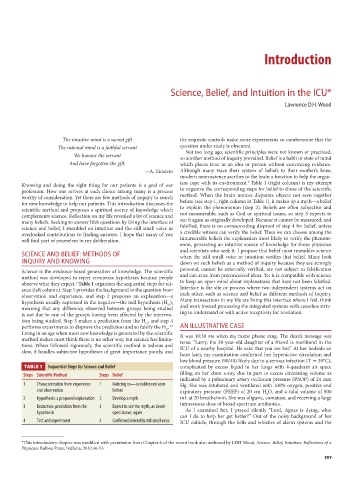
                      TABLE 1    Sequential Steps for Science and Belief  complicated by excess liquid in her lungs with 4-quadrant air space
                    Steps Scientific Method   Steps Belief                filling on her chest x-ray, due in part to excess circulating volume as
                                                                          indicated by a pulmonary artery occlusion pressure (PAOP) of 24 mm
                    1    Characterization from experience   1  Noticing co—variables not seen   Hg. She was intubated and ventilated with 100% oxygen, positive end
                         and observation           before                 expiratory pressure (PEEP) of 20 cm H O, and a tidal volume of 800
                                                                                                       2
                    2    Hypothesis: a proposed explanation 2  Develop a myth  mL at 20 breaths/min. She was oliguric, comatose, and receiving a large
                    3    Deduction: prediction from the   3  Expect to see the myth, as devel-  intravenous dose of broad spectrum antibiotics.
                         hypothesis                oped above, again       As I examined her, I prayed silently “Lord, Agnes is dying, what
                    4    Test and experiment  4    Confirmed/denied by still small voice  can I do to help her get better?” Out of the noisy background of her
                                                                          ICU cubicle, through the bells and whistles of alarm systems and the


                    *This introductory chapter was modified with permission from Chapter 6 of the recent book also authored by LDH Wood, Science, Belief, Intuition: Reflections of a
                    Physican. Balboa Press, Indiana; 2012:46-53.
                                                                                                                           xxv


            intro.indd   25                                                                                             19-01-2015   16:50:50

