


Page 676 - Hall et al (2015) Principles of Critical Care-McGraw-Hill
P. 676
CHAPTER 54: Acute-on-Chronic Respiratory Failure  495


                      ventilation (16.6 ± 11.8 days and 10.2 ± 6.8 days; p = 0.021) ICU days     For many patients, liberation from prolonged mechanical ventilation
                    (24.0  ± 13.7 days and 15.1  ± 5.4 days;  p  = 0.005), incidence of   is associated with a decision to change the goals of care from treatment-
                      nosocomial pneumonia, and mortality at 60 days (8% NIV vs 28%   for-cure to treatment-for-comfort. Decisions to withhold and withdraw
                    invasive ventilation; p = 0.009), while increasing approximately four-  life-sustaining therapy entail extensive involvement of the patient, their
                    fold the number of patients liberated from ventilation at day 21.  In   care providers, ICU staff, chaplaincy, hospital ethics, and social work
                                                                   213
                    a meta-analysis of 12 studies, 530 predominantly COPD patients were   support. Pertinent to the terminal care of the ACRF patient, are meticu-
                    generally randomized to one of the two strategies after failing only a   lous attention to palliation of terminal dyspnea, pain, and delirium. This
                    single SBT. Extubation to NIV translated into an aggregate 45% rela-  subject is covered in Chap. 18.
                    tive risk reduction for mortality (95% CI 21%-62%) at 30 to 90 days.
                                                                      214
                    Secondary outcomes were consistent in magnitude and direction with   QUALITY PERFORMANCE MEASUREMENT
                    significant reductions in VAP (RR 0.29, 95% CI 0.19-0.45), ICU length   AND REPORTING FOR ACRF
                                  https://kat.cr/user/tahir99/
                    of stay (weighted mean difference [WMD] −6.27 days, 95% CI −8.77
                    to −3.78) and total duration of ventilation (WMD) −5.64 days (95%   Efforts to improve the consistency and quality of care delivery for
                    CI −9.50 to −1.77). Extubation had no effect on failures to liberate or   critically ill patients while containing costs has become a major focus
                    duration of ventilation related to efforts to liberate.  NIV is likely to   internationally. Process, structure, and outcomes measures for ACRF
                                                          214
                    tide the patient over the additional days until the balance of neuromus-  have been developed and in some countries are used for public report-
                    cular competence and respiratory system load is reestablished and we   ing of hospital care and value-based purchasing. As an example, the
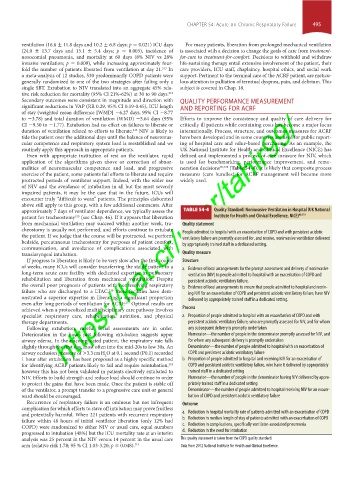
                    routinely apply this approach in appropriate patients.  UK National Institute for Health and Clinical Excellence (NICE) has
                     Even with  appropriate institution  of  rest on the ventilator,  rapid   defined and implemented a process-of-care measure for NIV, which
                    application of the algorithms given above or correction of abnor-  is used for benchmarking, performance improvement, and remu-
                    malities  of  neuromuscular competence and load, and progressive   neration decisions 90,220  (Table 54-4). It is likely that composite process
                    exercise of the patient, some patients fail efforts to liberate and require   measures (care bundles) for ACRF management will become more
                    protracted periods of ventilator support. Indeed, with the wider use   widely used.
                    of NIV and the avoidance of intubation in all but the most severely
                    impaired patients, it may be the case that in the future, ICUs will
                    encounter truly “difficult to wean” patients. The principles elaborated
                    above still apply to this group, with a few additional comments. After
                    approximately 7 days of ventilator dependence, we typically assess the     TABLE 54-4     Quality Standard: Noninvasive Ventilation in Hospital (UK National
                    patient for tracheostomy  (see Chap. 46). If it appears that liberation   Institute for Health and Clinical Excellence, NICE) 89,219
                                      215
                    from mechanical ventilation may succeed within another week, tra-  Quality statement
                    cheostomy is usually not performed, and efforts continue to extubate   People admitted to hospital with an exacerbation of COPD and with persistent acidotic
                    the patient. If we judge that the course will be protracted, we perform   ventilatory failure are promptly assessed for, and receive, noninvasive ventilation delivered
                    bedside, percutaneous tracheostomy for purposes of patient comfort,   by appropriately trained staff in a dedicated setting.
                    communication, and avoidance of complications associated with
                    translaryngeal intubation.                            Quality measure
                     If progress to liberation is likely to be very slow after the first couple   Structure
                    of weeks, many ICUs will consider transferring the stable patient to a     a.   Evidence of local arrangements for the prompt assessment and delivery of noninvasive
                    long-term acute care facility with dedicated expertise in pulmonary   ventilation (NIV) to people admitted to hospital with an exacerbation of COPD and
                    rehabilitation and liberation from mechanical ventilation. Despite   persistent acidotic ventilatory failure.
                    the overall poor prognosis of patients with nonresolving respiratory     b.   Evidence of local arrangements to ensure that people admitted to hospital and receiv-
                    failure who are discharged to a LTAC,  these facilities have dem-  ing NIV for an exacerbation of COPD and persistent acidotic ventilatory failure, have NIV
                                                 216
                    onstrated  a superior  expertise in  liberating  a significant proportion   delivered by appropriately trained staff in a dedicated setting.
                    even after long periods of ventilation for ACRF.  Optimal results are
                                                       217
                    achieved when a protocolized multidisciplinary care pathway involves   Process
                    specialist respiratory care, rehabilitation, nutrition, and physical     a.   Proportion of people admitted to hospital with an exacerbation of COPD and with
                    therapy departments.                                    persistent acidotic ventilatory failure, who are promptly assessed for NIV, and for whom
                     Following extubation, careful serial assessments are in order.   any subsequent delivery is promptly undertaken
                    Deterioration in the hours just following extubation suggests upper   Numerator—the number of people in the denominator promptly assessed for NIV, and
                    airway edema. In the uncomplicated patient, the respiratory rate falls   for whom any subsequent delivery is promptly undertaken
                    slightly through the first day, most often into the mid-20s to low 30s. An   Denominator—the number of people admitted to hospital with an exacerbation of
                    airway occlusion pressure of >3.3 cm H O at 0.1 second (P0.1) recorded   COPD and persistent acidotic ventilatory failure
                                                2
                    1 hour after extubation has been proposed as a highly specific method     b.   Proportion of people admitted to hospital and receiving NIV for an exacerbation of
                    for identifying ACRF patients likely to fail and require reintubation,    COPD and persistent acidotic ventilatory failure, who have it delivered by appropriately
                                                                      218
                    however this has not been validated in patients electively extubated to   trained staff in a dedicated setting
                    NIV. Efforts to build strength and reduce load should continue in order   Numerator—the number of people in the denominator having NIV delivered by appro-
                    to protect the gains that have been made. Once the patient is stable off   priately trained staff in a dedicated setting
                    of the ventilator, a prompt transfer to a progressive care unit or general   Denominator—the number of people admitted to hospital receiving NIV for an exacer-
                    ward should be encouraged.                              bation of COPD and persistent acidotic ventilatory failure
                     Recurrence of respiratory failure is an ominous but not infrequent   Outcome
                    complication for which efforts to stave off intubation may prove fruitless
                    and potentially harmful. When 221 patients with recurrent respiratory     a.  Reduction in hospital mortality rate of patients admitted with an exacerbation of COPD
                    failure within 48 hours of initial ventilator liberation (only 12% had     b.  Reduction in median length of stay of patients admitted with an exacerbation of COPD
                    COPD) were randomized to either NIV or usual care, equal numbers    c.  Reduction in complications, specifically ventilator-associated pneumonia
                    progressed to intubation (48%) but the ICU mortality rate at an interim     d.  Reduction in the need for intubation
                    analysis was 25 percent in the NIV versus 14 percent in the usual care   This quality statement is taken from the COPD quality standard.
                    arm (relative risk 1.78; 95 % CI 1.03-3.20; p = 0.048). 219  Data from 2012 National Institute for Health and Clinical Excellence.


            section04.indd   495                                                                                       1/23/2015   2:20:10 PM

