


Page 680 - Hall et al (2015) Principles of Critical Care-McGraw-Hill
P. 680
CHAPTER 55: Status Asthmaticus  499


                    Observation for 60 minutes after the last β-agonist dose helps ensure   in the most severely obstructed patients who would be receiving higher
                    stability prior to discharge. Written medication instructions and an   doses of β-agonists, drug delivery is most impaired resulting in minimal
                    asthma action plan should be provided. In general, patients should be   systemic absorption and effect. In one study, albuterol delivered by MDI
                    discharged on oral corticosteroids. Inhaled corticosteroids (ICSs) should   with spacer to a total dose of 1600 μg over 90 minutes was not associated
                                                                                                                            77
                    be continued (or even initiated) in the ED and follow-up appointments   with increased  cardiovascular morbidity in well-oxygenated patients.
                    should be made.                                       After the first hour, dosing depends on clinical response and side effects.
                     Patients with severe airflow obstruction demonstrating a poor response   Long-acting  β-agonists (LABAs) are not recommended for treat-
                    to initial therapy and patients who deteriorate despite therapy should   ment of acute asthma, although limited data do show that formoterol
                    be admitted to an ICU. Other indications for ICU admission include   (which has quick onset of action) is effective and safe in this setting.
                    respiratory arrest, altered mental status, hypercapnia, arrhythmias, acute   Combination therapy with a LABA and an ICS may be initiated or con-
                                                                                                                   78
                    coronary syndrome, and need for frequent inhaler treatments.  tinued in hospitalized patients receiving rescue therapy,  and may be
                                  https://kat.cr/user/tahir99/
                     An incomplete response to treatment is defined as the persistence of   required to achieve adequate outpatient control and decrease the risk of
                    mild wheezing or dyspnea and a PEFR or FEV  between 50% and 69%   future exacerbations.
                                                      1
                    of predicted.  Patients in this group should be assessed individually,   Subcutaneous β-agonists are not recommended unless the patient is
                             1
                    and while selected low-risk patients may be safely discharged from the   unable to comply with inhaled therapy (such as those with an altered
                    ED, others require ongoing treatment in either the ED or the medi-  mental status or impending cardiopulmonary arrest). They are no more
                    cal ward. Extended ED evaluation allows for assessment of the initial   effective in the initial management of acutely ill asthmatics and are
                    response to systemic corticosteroids, and for those who are discharged   associated with greater toxicity. 79-81  However, subcutaneous epinephrine
                    home decreases the risk of relapse and return to the ED.  If the patient   may benefit some patients not responding to several hours of an inhaled
                                                            34
                    demonstrates a good response to treatment over that period of time and   β-agonist.  Known cardiac disease  and  age  >40 years  are  relative
                                                                                 82
                    close follow-up can be arranged, discharge home may be appropriate.   contraindications to parenteral therapy.  Intravenous infusions of
                                                                                                        83
                    Again, these patients have better outcomes if they receive a course of   β-agonists are not recommended because they are more toxic and less
                    oral steroids.  Patients who continue to have an incomplete response   efficacious than inhaled treatments. 84-88
                             69
                    should be admitted to a medical ward. Admission is also recommended   Approximately two-thirds of patients respond to inhaled albuterol in a
                    when there is a harmful home environment or medical noncompliance.  convincing dose-dependent fashion, generally allowing discharge home
                                                                          from the ED.  In these patients, 1.2 to 2.4 mg albuterol delivered by
                                                                                    89
                    THERAPY PRIOR TO INTUBATION                           MDI and spacer or 5 to 7.5 mg by nebulizer in the first hour is effective.
                        ■  PHARMACOTHERAPY                                presumably because airway inflammation and mucus plugging adversely
                                                                          In the remaining one-third of patients albuterol has minimal effect,
                    β-Agonists:  Inhaled short-acting β-agonists (SABAs) are the cornerstone   affects the dose response relationship.
                    of treatment of smooth muscle–mediated bronchoconstriction and should   Ipratropium Bromide:  Overall, the data suggest an advantage in maximal
                    be given immediately regardless of prior use (Table 55-1).  Albuterol is   bronchodilation response when ipratropium bromide and albuterol are
                                                             70
                    the  most  widely  used  SABA,  but  others  are available  including  levalb-  combined in the initial emergency treatment of asthma. 90-100  However,
                    uterol, bitolterol, and pirbuterol. Levalbuterol in one-half the milligram   several studies that generally used small doses of ipratropium bromide
                    dose of albuterol provides comparable efficacy and safety by metered dose   showed little or no benefit to this combination, 101-105  and the addition
                    inhaler (MDI), but has not been studied by continuous administration. 62  of ipratropium bromide has not been shown to provide further benefit
                     Guidelines recommend repetitive or continuous administration   once the patient is hospitalized. 62
                    depending on clinical response and side effects. A common strategy   Combination therapy is recommended for patients critically ill on
                    is to give albuterol 2.5 mg by nebulization every 20 minutes during   first presentation or not responding quickly (eg, within 30 minutes)
                    the first hour of ED management.  Continuous administration (at the   to albuterol alone. The Expert Panel of the NIH recommends adding
                                             62
                    same total dose) may be slightly superior to repetitive dosing in patients   0.5 mg of ipratropium bromide to 2.5 mg of albuterol by nebulizer every
                    with severe exacerbations, although there is little difference between   20 minutes for three doses, then as needed. Alternatively combination
                    these two strategies in most cases. 71-74  Albuterol can also be delivered   of four to eight puffs of ipratropium bromide MDI and four to eight
                    effectively by MDI with a spacer; four to eight puffs of albuterol by MDI   puffs of albuterol (or eight puffs of a combination albuterol/ipratropium
                    with spacer is equivalent to a 2.5-mg nebulizer treatment. 75,76  MDIs   bromide inhaler) can be given every 20 minutes for the first 1 to 3 hours
                    with spacers are less expensive and faster, but handheld nebulizers   as guided by clinical response and toxicity. 62
                    require less supervision and coordination. Fortunately, frequent doses   Corticosteroids:  Systemic corticosteroids should be administered quickly
                    of β-agonists are  generally well tolerated. This may relate to the fact that
                                                                          to  patients  not responding  in an  immediate, marked,  and durable
                                                                          manner to initial bronchodilator therapy, particularly since benefits
                                                                          are not immediately evident. Indeed McFadden’s group demonstrated
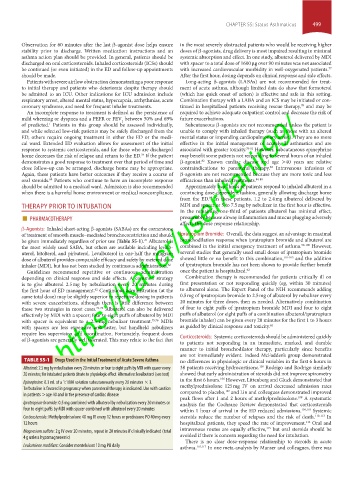
                      TABLE 55-1    Drugs Used in the Initial Treatment of Acute Severe Asthma  no differences in physiologic or clinical variables in the first 6 hours in
                                                                                                     105
                    Albuterol: 2.5 mg by nebulization every 20 minutes or four to eight puffs by MDI with spacer every   38 patients receiving hydrocortisone.  Rodrigo and Rodrigo similarly
                    20 minutes; for intubated patients titrate to physiologic effect. Alternative: levalbuterol (see text)  showed that early administration of steroids did not improve spirometry
                                                                          in the first 6 hours.  However, Littenberg and Gluck demonstrated that
                                                                                       106
                    Epinephrine: 0.3 mL of a 1:1000 solution subcutaneously every 20 minutes × 3.
                    Terbutaline is favored in pregnancy when parenteral therapy is indicated. Use with caution   methylprednisolone  125 mg  IV  on  arrival  decreased  admission  rates
                                                                          compared to placebo,  and Lin and colleagues demonstrated improved
                                                                                         107
                    in patients >age 40 and in the presence of cardiac disease
                                                                                                                  108
                                                                          peak flows after 1 and 2 hours of methylprednisolone.  A systematic
                    Ipratropium bromide: 0.5 mg combined with albuterol by nebulization every 20 minutes or   analysis for the Cochrane Review demonstrated that corticosteroids
                    four to eight puffs by MDI with spacer combined with albuterol every 20 minutes  within 1 hour of arrival in the ED reduced admissions. 109,110  Systemic
                    Corticosteroids: Methylprednisolone 40 mg IV every 12 hours or prednisone PO 40 mg every   steroids reduce the number of relapses and the risk of death. 110-113  In
                                                                                                                    114
                    12 hours                                              hospitalized patients, they speed the rate of improvement.  Oral and
                                                                                                       115
                    Magnesium sulfate: 2 g IV over 20 minutes, repeat in 20 minutes if clinically indicated (total   intravenous routes are equally effective,  but oral steroids should be
                    4 g unless hypomagnesemic)                            avoided if there is concern regarding the need for intubation.
                                                                           There is no clear dose-response relationship to steroids in acute
                    Leukotriene modifiers: Consider montelukast 10 mg PO daily
                                                                          asthma. 116,117  In one meta-analysis by Manser and colleagues, there was


            section04.indd   499                                                                                       1/23/2015   2:20:12 PM

