


Page 822 - Hall et al (2015) Principles of Critical Care-McGraw-Hill
P. 822
CHAPTER 62: Sepsis and Immunoparalysis  553


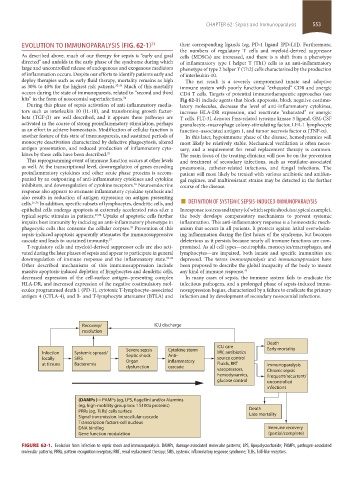
                    EVOLUTION TO IMMUNOPARALYSIS (Fig. 62-1)    31        their corresponding ligands (eg, PD-1 ligand [PD-L1]). Furthermore,
                                                                          the numbers of regulatory T cells and myeloid-derived suppressor
                    As described above, much of our therapy for sepsis is “early and goal   cells  (MDSCs)  are  increased,  and  there  is  a  shift  from  a  phenotype
                    directed” and unfolds in the early phase of the syndrome during which   of inflammatory type 1 helper T (Th1) cells to an anti-inflammatory
                    large and uncontrolled release of endogenous and exogenous mediators   phenotype of type 2 helper T (Th2) cells characterized by the production
                    of inflammation occurs. Despite our efforts to identify patients early and   of interleukin-10.
                    deploy therapies such as early fluid therapy, mortality remains as high   The net result is a severely compromised innate and adaptive
                    as 30% to 40% for the highest risk patients. 32-34  Much of this mortality   immune system with poorly functional “exhausted” CD8 and anergic
                    occurs during the state of immunoparesis, related to “second and third   CD4 T cells. Targets of potential immunotherapeutic approaches (see
                    hits” in the form of nosocomial superinfections. 34   Fig 62-1) include agents that block apoptosis, block negative costimu-
                     During this phase of sepsis activation of anti-inflammatory media-  latory molecules, decrease the level of anti-inflammatory cytokines,
                    tors such as interleukin 10 (IL-10), and transforming growth factor-  increase HLA-DR expression, and reactivate “exhausted” or anergic
                    beta (TGF-β) are well described, and it appears these pathways are   T cells. FLT-3L denotes Fms-related tyrosine kinase 3 ligand, GM-CSF
                    activated in the course of strong proinflammatory stimulation, perhaps     granulocyte– macrophage colony-stimulating factor, LFA-1 lymphocyte
                    as an effort to achieve homeostasis. Modification of cellular function is   function–associated antigen 1, and tumor necrosis factor α (TNF-α).
                    another feature of this state of immunoparesis, and sustained periods of   In this later, hypoimmune phase of the disease, hemodynamics will
                    monocyte deactivation characterized by defective phagocytosis, altered   most likely be relatively stable. Mechanical ventilation is often neces-
                    antigen presentation, and reduced production of inflammatory cyto-  sary, and a requirement for renal replacement therapy is common.
                    kines by these cells have been described. 25          The main focus of the treating clinician will now be on the prevention
                     This reprogramming event of immune function occurs at other levels   and treatment of secondary infections, such as ventilator-associated
                    as well. At the transcriptional level, downregulation of genes encoding   pneumonia,  catheter-related  infections,  and  fungal  infections.  The
                    proinflammatory cytokines and other acute phase proteins is accom-  patient will most likely be treated with various antibiotic and antifun-
                    panied by an outpouring of anti-inflammatory cytokines and cytokine   gal regimes, and multiresistant strains may be detected in the further
                    inhibitors, and downregulation of cytokine receptors.  Neuroendocrine   course of the disease.
                                                          35
                    response also appears to attenuate inflammatory cytokine synthesis and
                          In addition, specific subsets of lymphocytes, dendritic cells, and   ■
                    also results in reduction of antigen expression on antigen presenting
                    cells. 25,36                                            DEFINITION OF SYSTEMIC SEPSIS-INDUCED IMMUNOPARALYSIS
                    epithelial cells undergo apoptosis at extremely accelerated rates after a   In response to stress and injury (of which septic shock is a typical example),
                    typical septic stimulus in patients. 37,38  Uptake of apoptotic cells further   the body develops compensatory mechanisms to prevent systemic
                    impairs host immunity by inducing an anti-inflammatory phenotype in   inflammation. This anti-inflammatory response is a homeostatic mech-
                    phagocytic cells that consume the cellular corpses.  Prevention of this   anism that occurs in all patients. It protects against lethal overwhelm-
                                                         39
                    sepsis-induced apoptosis apparently attenuates the immunosuppressive   ing inflammation during the first hours of the syndrome, but becomes
                    cascade and leads to sustained immunity. 37           deleterious as it persists because nearly all immune functions are com-
                     T-regulatory cells and myeloid-derived suppressor cells are also acti-  promised. As all cell types—neutrophils, monocytes/macrophages, and
                    vated during the later phases of sepsis and appear to participate in general   lymphocytes—are impaired, both innate and specific immunities are
                    downregulation of immune response and the inflammatory state. 39-42    depressed.  The  terms  immunoparalysis  and  immunosuppression  have
                    Other described mechanisms of this immunosuppression include    been proposed to describe the global incapacity of the body to mount
                    massive apoptosis-induced depletion of lymphocytes and dendritic cells,   any kind of immune response. 43
                    decreased expression of the cell-surface antigen–presenting complex   In many cases of sepsis, the immune system fails to eradicate the
                    HLA-DR, and increased expression of the negative costimulatory mol-  infectious pathogens, and a prolonged phase of sepsis-induced immu-
                    ecules programmed death 1 (PD-1), cytotoxic T-lymphocyte–associated   nosuppression begins, characterized by a failure to eradicate the primary
                    antigen 4 (CTLA-4), and B- and T-lymphocyte attenuator (BTLA) and   infection and by development of secondary nosocomial infections.


                                        Recovery/                ICU discharge
                                        resolution

                                                                                                       Death
                                                                                      ICU care
                                                       Severe sepsis  Cytokine storm                   Early mortality
                           Infection  Systemic spread/  Septic shock  Anti-           MV, antibiotics
                           locally    SIRS             Organ          inflammatory    source control
                           at tissues  Bacteremia                                     Fluids, RRT      Immunoparalysis
                                                       dysfunction    cascade
                                                                                      vasopressors,    Chronic sepsis
                                                                                      hemodynamics,    Frequent/recurrent/
                                                                                      glucose control  uncontrolled
                                                                                                       infections
                                       (DAMPs ) = PAMPs (eg, LPS, flagellin) and/or Alarmins
                                       (eg, high-mobility group box 1 S100a proteins)
                                       PRRs (eg, TLRs) cells surface                             Death
                                                                                                 Late mortality
                                       Signal transmission. Intracellular cascade
                                       Transcription factors-cell nucleus
                                       DNA binding                                                      Immune recovery
                                       Gene function modulation                                         (partial/complete)
                    FIGURE 62-1.  Evolution from infection to septic shock and immunoparalysis. DAMPs, damage-associated molecular patterns; LPS, lipopolysaccharide; PAMPs, pathogen-associated
                    molecular patterns; PRRs, pattern recognition receptors; RRT, renal replacement therapy; SIRS, systemic inflammatory response syndrome; TLRs, Toll-like receptors.


            section05_c61-73.indd   553                                                                                1/23/2015   12:47:15 PM

