


Page 883 - Hall et al (2015) Principles of Critical Care-McGraw-Hill
P. 883
614     PART 5: Infectious Disorders


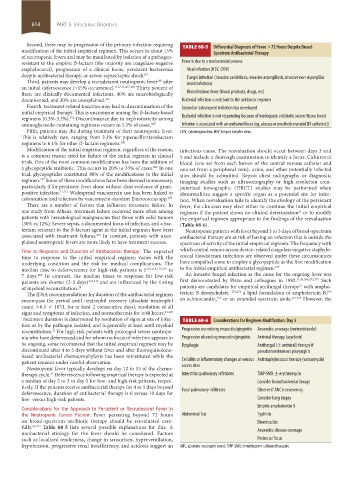
                   Second, there may be progression of the primary infection requiring     TABLE 68-5     Differential Diagnosis of Fever >72 Hours Despite Broad-
                 modification of the initial empirical regimen. This occurs in about 15%   Spectrum Antibacterial Therapy
                 of neutropenic fevers and may be manifested by isolation of a pathogen-
                 resistant to the empiric β-lactam (the majority are coagulase-negative   Fever is due to a nonbacterial process
                 staphylococci), progression of a clinical focus, persistent bacteremia     Viral infection (HSV, CMV)
                 despite antibacterial therapy, or severe sepsis/septic shock 113     Fungal infection (invasive candidiasis, invasive aspergillosis, invasive non-Aspergillus
                   Third, patients may develop a recrudescent neutropenic fever  after   mold infection)
                                                                266
                 an initial defervescence (~15% occurrence). 112,113,267-269  Thirty percent of
                 these  are  clinically  documented  infections,  40%  are  microbiologically     Noninfectious fever (blood products, drugs, etc)
                 documented, and 30% are unexplained. 269               Bacterial infection is resistant to the antibiotic regimen
                   Fourth, treatment-related toxicities may lead to discontinuation of the   Second or subsequent infection has developed
                 initial empirical therapy. This is uncommon among the β-lactam-based
                 regimens (0.3%-3.2%).  Discontinuance due to nephrotoxicity among   Bacterial infection is not responding because of inadequate antibiotic serum/tissue levels
                                  262
                 aminoglycoside-containing regimens occurs in 5.5% of cases. 208  Infection is associated with an undrained focus (eg, abscess or prosthetic material [IV catheters])
                   Fifth, patients may die during treatment of their neutropenic fever.   CMV, cytomegalovirus; HSV, herpes simplex virus.
                 This  is  relatively  rare,  ranging  from 3.3%  for  piperacillin/tazobactam
                 regimens to 6.1% for other β-lactam regimens. 262
                   Modification of the initial empirical regimen, regardless of the reason,     infectious cause. The reevaluation should occur between days 3 and
                 is a common reason cited for failure of the initial regimen in clinical   5 and include a thorough examination to identify a focus. Cultures of
                 trials. One of the most common modifications has been the addition of   blood (one set from each lumen of the central venous catheter and
                 a glycopeptide antibiotic. This occurs in 20% to 33% of cases.  In one   one set from a peripheral vein), urine, and other potentially infected
                                                              262
                 trial, glycopeptides constituted 88% of the modifications to the initial   sites should be submitted. Repeat chest radiography or diagnostic
                 regimen.  Some of these modifications have been deemed unnecessary,   imaging  studies such  as  ultrasonography or high-resolution com-
                        177
                 particularly if for persistent fever alone without clear evidence of gram-  puterized tomographic (HRCT) studies may be performed when
                 positive infection. 21,113  Widespread vancomycin use has been linked to   abnormalities suggest a specific organ as a potential site for infec-
                 colonization and infection by vancomycin-resistant Enterococcus spp. 270  tion. When reevaluation fails to identify the etiology of the persistent
                   There are a number of factors that influence treatment failure. In   fever, the clinician may elect either to continue the initial empirical
                 one study from Athens, treatment failure occurred more often among   regimen if the patient shows no clinical deterioration  or to modify
                                                                                                                21
                 patients with hematological malignancies that those with solid tumors   the empirical regimen appropriate to the findings of the reevaluation
                 (30% vs 12%). Severe sepsis, a documented focus of infection, and a bac-  (Table 68-6).
                 terium resistant to the β-lactam agent in the initial regimen have been   Neutropenic patients with fever beyond 3 to 5 days of broad-spectrum
                 associated  with  treatment  failures.   In  contrast,  patients  with  unex-  antibacterial therapy are at risk of having an infection that is outside the
                                           264
                 plained neutropenic fevers are more likely to have treatment success.  spectrum of activity of the initial empirical regimen. The frequency with
                 Time to Response and Duration of Antibacterial therapy:  The  expected   which central venous access device–related coagulase-negative staphylo-
                 time to response to the initial empirical regimen varies with the   coccal bloodstream infections are observed under these circumstances
                 underlying condition and the risk for medical complications. The   have compelled some to employ a glycopeptide as the first modification
                 median time to defervescence for high-risk patients is 5 113,115,177,271  to     to the initial empirical antibacterial regimen. 177
                 7 days.  In contrast, the median times to response for low-risk   An invasive fungal infection as the cause for the ongoing fever was
                       204
                 patients are shorter (2-3 days) 218,219  and are influenced by the timing   first demonstrated by Pizzo and colleagues in 1982. 21,65,266,272,273  Such
                                                                                                                21
                 of myeloid reconstitution. 28                         patients are candidates for empirical antifungal therapy  with ampho-
                                                                                                                         275
                   The IDSA recommendations for duration of the antibacterial regimen   tericin B deoxycholate,  273,274  a lipid formulation of amphotericin B,
                                                                                    276
                 encompass the period until neutrophil recovery (absolute neutrophil   an echinocandin,  or an extended spectrum azole. 277,278  However, the
                 count >0.5 × 10 /L for at least 2 consecutive days), resolution of all
                              9
                 signs and symptoms of infection, and normothermia for ≥48 hours. 21,129
                 Treatment duration is determined by resolution of signs at site of infec-    TABLE 68-6    Considerations for Regimen Modification: Day 5
                 tion or by the pathogen isolated, and is generally at least until myeloid
                            21
                 reconstitution.  For high-risk patients with prolonged severe neutrope-  Progressive necrotizing mucositis/gingivitis  Anaerobic coverage (metronidazole)
                 nia who have defervesced and for whom no focus of infection appears to   Progressive ulcerating mucositis/gingivitis  Antiviral therapy (acyclovir)
                 be ongoing, some recommend that the initial empirical regimen may be   Dysphagia  Antifungal (± antiviral) therapy if
                 discontinued after 4 to 5 days without fever and after fluoroquinolone-            pseudomembranous pharyngitis
                 based antibacterial chemoprophylaxis has been reinstituted while  the
                 patient remains under careful observation.             Cellulitis or inflammatory changes at venous  Antistaphylococcal therapy (vancomycin)
                   Neutropenic fever typically develops on day 12 to 15 of the chemo-  access sites
                 therapy cycle.  Defervescence following empirical therapy is expected at   Interstitial pulmonary infiltrates  TMP-SMX ± erythromycin
                           31
                 a median of day 2 to 3 or day 5 for low- and high-risk patients, respec-         Consider bronchoalveolar lavage
                 tively. If the patients receive antibacterial therapy for 4 to 5 days beyond
                 defervescence, duration of antibacterial therapy is 6 versus 10 days for   Focal pulmonary infiltrates  Observe if ANC is recovering
                 low- versus high-risk patients.                                                  Consider lung biopsy
                                                                                                  Empiric amphotericin B
                 Considerations for the Approach to Persistent or Recrudescent Fever in
                 the Neutropenic Cancer Patient:  Fever persisting beyond 72 hours   Abdominal foci  Typhlitis
                 on broad-spectrum antibiotic therapy should be reevaluated care-                 Diverticulitis
                 fully. 65,224   Table 68-5 lists several possible explanations for this. A
                 nonbacterial etiology for the fever should be considered. Factors                Anaerobic disease coverage
                 such as localized tenderness, change in sensorium, hyperventilation,             Perirectal focus
                 hypotension, progressive renal insufficiency, and acidosis suggest an   ANC, absolute neutrophil count; TMP-SMX, trimethoprim-sulfamethoxazole.


            section05_c61-73.indd   614                                                                                1/23/2015   12:48:08 PM

