


Page 115 - Psychology of Wounds and Wound Care in Clinical Practice ( PDFDrive )
P. 115
Theories of QoL and Wellbeing  89


                      Health Status

                                  HRQoL   Quality of Life
                    Functional status


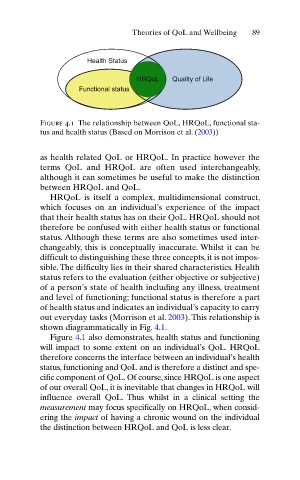
             Figure 4.1    The relationship between QoL, HRQoL, functional sta-
           tus and health status (Based on Morrison et al. (  2003 ))

           as health related QoL or HRQoL. In practice however the
           terms QoL and HRQoL are often used interchangeably,
           although it can sometimes be useful to make the distinction
           between HRQoL and QoL.
               HRQoL is itself a complex, multidimensional construct,
           which focuses on an individual’s experience of the impact
           that their health status has on their QoL. HRQoL should not
           therefore be confused with either health status or functional
           status. Although these terms are also sometimes used inter-
           changeably, this is conceptually inaccurate. Whilst it can be
           difficult to distinguishing these three concepts, it is not impos-
           sible. The difficulty lies in their shared characteristics. Health
           status refers to the evaluation (either objective or subjective)
           of a person’s state of health including any illness, treatment
           and level of functioning; functional status is therefore a part
           of health status and indicates an individual’s capacity to carry
           out everyday tasks (Morrison et al.   2003 ). This relationship is
           shown diagrammatically in Fig.   4.1 .
                Figure   4.1  also demonstrates, health status and functioning
           will impact to some extent on an individual’s QoL. HRQoL
           therefore concerns the interface between an individual’s health
           status, functioning and QoL and is therefore a distinct and spe-
           cific component of QoL. Of course, since HRQoL is one aspect
           of our overall QoL, it is inevitable that changes in HRQoL will
           influence overall QoL.  Thus whilst in a clinical setting the
              measurement  may focus specifically on HRQoL, when consid-
           ering the  impact  of having a chronic wound on the individual
           the distinction between HRQoL and QoL is less clear.

