


Page 171 - Psychology of Wounds and Wound Care in Clinical Practice ( PDFDrive )
P. 171
146  Chapter 6.  Treatment


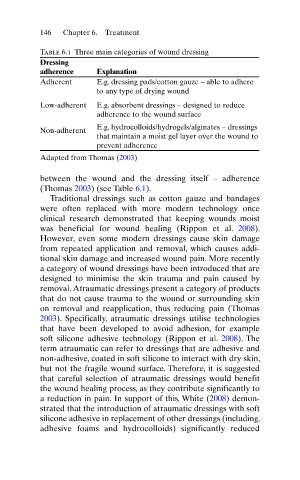
              Table 6.1   Three main categories of wound dressing
            Dressing
           adherence    Explanation
             Adherent     E.g. dressing pads/cotton gauze – able to adhere
                        to any type of drying wound
             Low- adherent       E.g. absorbent dressings – designed to reduce
                        adherence to the wound surface
                          E.g. hydrocolloids/hydrogels/alginates – dressings
            Non- adherent
                        that maintain a moist gel layer over the wound to
                        prevent adherence
             Adapted from Thomas (  2003 )

           between the wound and the dressing itself – adherence
           (Thomas   2003 ) (see Table  6.1 ).
                Traditional dressings such as cotton gauze and bandages
           were often replaced with more modern technology once
           clinical research demonstrated that keeping wounds moist
           was beneficial for wound healing (Rippon et al.   2008 ).
           However, even some modern dressings cause skin damage
           from repeated application and removal, which causes addi-
           tional skin damage and increased wound pain. More recently
           a category of wound dressings have been introduced that are
           designed to minimise the skin trauma and pain caused by
           removal. Atraumatic dressings present a category of products
           that do not cause trauma to the wound or surrounding skin
           on removal and reapplication, thus reducing pain (Thomas
             2003 ). Specifically, atraumatic dressings utilise technologies
           that have been developed to avoid adhesion, for example
           soft silicone adhesive technology (Rippon et al.   2008 ). The
           term atraumatic can refer to dressings that are adhesive and
           non- adhesive, coated in soft silicone to interact with dry skin,
           but not the fragile wound surface. Therefore, it is suggested
           that careful selection of atraumatic dressings would benefit
           the wound healing process, as they contribute significantly to
           a reduction in pain. In support of this, White (  2008 ) demon-
           strated that the introduction of atraumatic dressings with soft
           silicone adhesive in replacement of other dressings  (including,
           adhesive foams and hydrocolloids) significantly reduced

