


Page 172 - Psychology of Wounds and Wound Care in Clinical Practice ( PDFDrive )
P. 172
Dressing Change  147

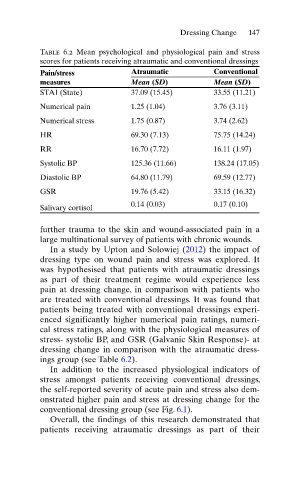
              Table  6.2     Mean psychological and physiological pain and stress
           scores for patients receiving atraumatic and conventional dressings
            Pain/stress          Atraumatic          Conventional
           measures                Mean  ( SD )       Mean  ( SD )
            STAI (State)         37.09 (15.45)       33.55 (11.21)

            Numerical pain       1.25 (1.04)         3.76 (3.11)
            Numerical stress     1.75 (0.87)         3.74 (2.62)
            HR                   69.30 (7.13)        75.75 (14.24)
            RR                   16.70 (7.72)        16.11 (1.97)
            Systolic BP          125.36 (11.66)      138.24 (17.05)
            Diastolic BP         64.80 (11.79)       69.59 (12.77)
            GSR                  19.76 (5.42)        33.15 (16.32)
                                 0.14 (0.03)         0.17 (0.10)
            Salivary cortisol

             further trauma to the skin and wound-associated pain in a
           large multinational survey of patients with chronic wounds.
               In a study by Upton and Solowiej (  2012 ) the impact of
           dressing type on wound pain and stress was explored. It
           was hypothesised that patients with atraumatic dressings
           as part of their treatment regime would experience less
           pain at dressing change, in comparison with patients who
           are treated with conventional dressings. It was found that
           patients being treated with conventional dressings experi-
           enced significantly higher numerical pain ratings, numeri-
           cal stress ratings, along with the physiological measures of
           stress- systolic BP, and GSR (Galvanic Skin Response)- at
           dressing change in comparison with the atraumatic dress-
           ings group (see Table   6.2 ).
                   In addition to the increased physiological indicators of
           stress amongst patients receiving conventional dressings,
           the self-reported severity of acute pain and stress also dem-
           onstrated higher pain and stress at dressing change for the
           conventional dressing group (see Fig.   6.1 ).
                Overall, the findings of this research demonstrated that
           patients receiving atraumatic dressings as part of their

