


Page 77 - Psychology of Wounds and Wound Care in Clinical Practice ( PDFDrive )
P. 77
50   Chapter 2.  Pain


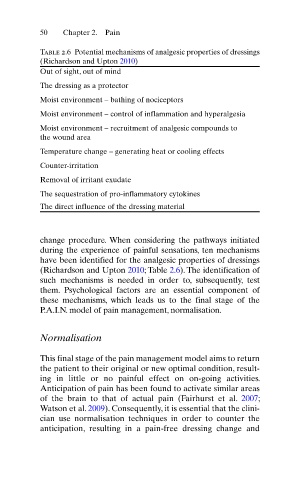
              Table 2.6    Potential mechanisms of analgesic properties of dressings
           (Richardson and Upton   2010 )
             Out of sight, out of mind
             The dressing as a protector
             Moist environment – bathing of nociceptors

             Moist environment – control of inflammation and hyperalgesia
             Moist environment – recruitment of analgesic compounds to
           the wound area
             Temperature change – generating heat or cooling effects
            Counter-irritation
             Removal of irritant exudate

             The sequestration of pro-inflammatory cytokines
             The direct influence of the dressing material


           change procedure. When considering the pathways initiated
           during the experience of painful sensations, ten mechanisms
           have been identified for the analgesic properties of dressings
           (Richardson and Upton   2010 ; Table  2.6 ). The identification of
           such mechanisms is needed in order to,  subsequently, test
           them. Psychological factors are an essential component of
           these mechanisms, which leads us to the final stage of the
           P.A.I.N. model of pain management, normalisation.


                  Normalisation

             This final stage of the pain management model aims to return
           the patient to their original or new optimal condition, result-
           ing in little or no painful effect on on-going activities.
           Anticipation of pain has been found to activate similar areas
           of the brain to that of actual pain (Fairhurst et al.   2007 ;
           Watson et al.   2009 ). Consequently, it is essential that the clini-
           cian use normalisation techniques in order to counter the
           anticipation, resulting in a pain-free dressing change and

