


Page 107 - Clinical Anatomy
P. 107
ECA2  7/18/06  6:42 PM  Page 92


                 92  The abdomen and pelvis


                   Numerous anomalies may occur in the highly complex developmental
                process.
                1◊◊Atresia or stenosis of the bowel may result from failure of recanalization of
                the lumen. Another cause of this may be damage to the blood supply to the
                bowel within the fetal umbilical hernia with consequent ischaemic
                changes. Imperforate anus—see page 83.
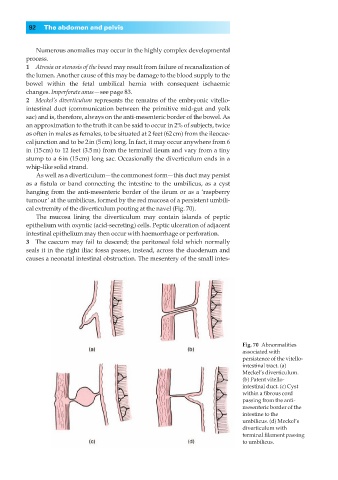
                2◊◊Meckel’s diverticulum represents the remains of the embryonic vitello-
                intestinal duct (communication between the primitive mid-gut and yolk
                sac) and is, therefore, always on the anti-mesenteric border of the bowel. As
                an approximation to the truth it can be said to occur in 2% of subjects, twice
                as often in males as females, to be situated at 2 feet (62cm) from the ileocae-
                cal junction and to be 2in (5cm) long. In fact, it may occur anywhere from 6
                in (15cm) to 12 feet (3.5m) from the terminal ileum and vary from a tiny
                stump to a 6in (15cm) long sac. Occasionally the diverticulum ends in a
                whip-like solid strand.
                   As well as a diverticulum—the commonest form—this duct may persist
                as a fistula or band connecting the intestine to the umbilicus, as a cyst
                hanging from the anti-mesenteric border of the ileum or as a ‘raspberry
                tumour’ at the umbilicus, formed by the red mucosa of a persistent umbili-
                cal extremity of the diverticulum pouting at the navel (Fig. 70).
                   The mucosa lining the diverticulum may contain islands of peptic
                epithelium with oxyntic (acid-secreting) cells. Peptic ulceration of adjacent
                intestinal epithelium may then occur with haemorrhage or perforation.
                3◊◊The caecum may fail to descend; the peritoneal fold which normally
                seals it in the right iliac fossa passes, instead, across the duodenum and
                causes a neonatal intestinal obstruction. The mesentery of the small intes-


                                                                              Fig. 70◊Abnormalities
                                                                              associated with
                                                                              persistence of the vitello-
                                                                              intestinal tract. (a)
                                                                              Meckel’s diverticulum.
                                                                              (b) Patent vitello-
                                                                              intestinal duct. (c) Cyst
                                                                              within a fibrous cord
                                                                              passing from the anti-
                                                                              mesenteric border of the
                                                                              intestine to the
                                                                              umbilicus. (d) Meckel’s
                                                                              diverticulum with
                                                                              terminal filament passing
                                                                              to umbilicus.

