


Page 138 - Clinical Anatomy
P. 138
ECA2  7/18/06  6:43 PM  Page 123


                                                                     The male genital organs   123


                                       (a)              (b)              (c)             (d)
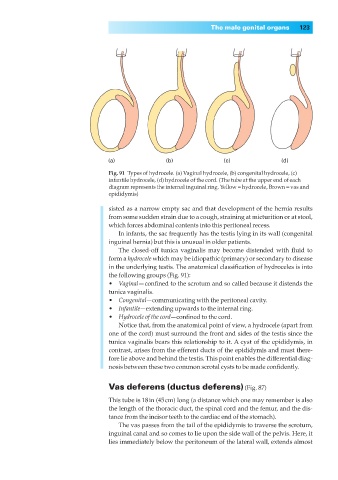
                                        Fig. 91◊Types of hydrocele. (a) Vaginal hydrocele, (b) congenital hydrocele, (c)
                                        infantile hydrocele, (d) hydrocele of the cord. (The tube at the upper end of each
                                        diagram represents the internal inguinal ring. Yellow = hydrocele, Brown = vas and
                                        epididymis)

                                        sisted as a narrow empty sac and that development of the hernia results
                                        from some sudden strain due to a cough, straining at micturition or at stool,
                                        which forces abdominal contents into this peritoneal recess.
                                          In infants, the sac frequently has the testis lying in its wall (congenital
                                        inguinal hernia) but this is unusual in older patients.
                                          The closed-off tunica vaginalis may become distended with fluid to
                                        form a hydrocele which may be idiopathic (primary) or secondary to disease
                                        in the underlying testis. The anatomical classification of hydroceles is into
                                        the following groups (Fig. 91):
                                        •◊◊Vaginal— confined to the scrotum and so called because it distends the
                                        tunica vaginalis.
                                        •◊◊Congenital—communicating with the peritoneal cavity.
                                        •◊◊Infantile—extending upwards to the internal ring.
                                        •◊◊Hydrocele of the cord—confined to the cord.
                                          Notice that, from the anatomical point of view, a hydrocele (apart from
                                        one of the cord) must surround the front and sides of the testis since the
                                        tunica vaginalis bears this relationship to it. A cyst of the epididymis, in
                                        contrast, arises from the efferent ducts of the epididymis and must there-
                                        fore lie above and behind the testis. This point enables the differential diag-
                                        nosis between these two common scrotal cysts to be made confidently.


                                        Vas deferens (ductus deferens) (Fig. 87)
                                        This tube is 18in (45cm) long (a distance which one may remember is also
                                        the length of the thoracic duct, the spinal cord and the femur, and the dis-
                                        tance from the incisor teeth to the cardiac end of the stomach).
                                          The vas passes from the tail of the epididymis to traverse the scrotum,
                                        inguinal canal and so comes to lie upon the side wall of the pelvis. Here, it
                                        lies immediately below the peritoneum of the lateral wall, extends almost

