


Page 140 - Clinical Anatomy
P. 140
ECA2  7/18/06  6:43 PM  Page 125


                                                             The bony and ligamentous pelvis   125


                                                                                 Iliac crest

                                           Anterior gluteal line
                                                                                 Anterior superior spine
                                          Posterior gluteal line
                                        Posterior superior spine                 Inferior gluteal line
                                         Posterior inferior spine                Anterior inferior spine
                                          Greater sciatic notch                  Acetabulum
                                                                                 Iliopectineal eminence
                                                 Ischial spine
                                                                                 Superior ramus
                                           Lesser sciatic notch                  Pubic tubercle
                                            Obturator foramen                    Body of pubis
                  Fig. 92 Lateral view of    Ischial tuberosity                  Inferior ramus
                                                                                 Ramus of ischium
                  the os innominatum.

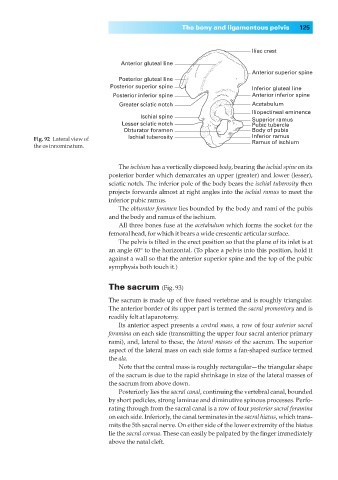
                                          The ischium has a vertically disposed body, bearing the ischial spine on its
                                        posterior border which demarcates an upper (greater) and lower (lesser),
                                        sciatic notch. The inferior pole of the body bears the ischial tuberosity then
                                        projects forwards almost at right angles into the ischial ramus to meet the
                                        inferior pubic ramus.
                                          The obturator foramen lies bounded by the body and rami of the pubis
                                        and the body and ramus of the ischium.
                                          All three bones fuse at the acetabulum which forms the socket for the
                                        femoral head, for which it bears a wide crescentic articular surface.
                                          The pelvis is tilted in the erect position so that the plane of its inlet is at
                                        an angle 60° to the horizontal. (To place a pelvis into this position, hold it
                                        against a wall so that the anterior superior spine and the top of the pubic
                                        symphysis both touch it.)


                                        The sacrum (Fig. 93)
                                        The sacrum is made up of five fused vertebrae and is roughly triangular.
                                        The anterior border of its upper part is termed the sacral promontory and is
                                        readily felt at laparotomy.
                                          Its anterior aspect presents a central mass, a row of four anterior sacral
                                        foramina on each side (transmitting the upper four sacral anterior primary
                                        rami), and, lateral to these, the lateral masses of the sacrum. The superior
                                        aspect of the lateral mass on each side forms a fan-shaped surface termed
                                        the ala.
                                          Note that the central mass is roughly rectangular—the triangular shape
                                        of the sacrum is due to the rapid shrinkage in size of the lateral masses of
                                        the sacrum from above down.
                                          Posteriorly lies the sacral canal, continuing the vertebral canal, bounded
                                        by short pedicles, strong laminae and diminutive spinous processes. Perfo-
                                        rating through from the sacral canal is a row of four posterior sacral foramina
                                        on each side. Inferiorly, the canal terminates in the sacral hiatus, which trans-
                                        mits the 5th sacral nerve. On either side of the lower extremity of the hiatus
                                        lie the sacral cornua. These can easily be palpated by the finger immediately
                                        above the natal cleft.

