


Page 198 - Clinical Anatomy
P. 198
ECA3  7/18/06  6:45 PM  Page 183


                                                       The bones and joints of the upper limb  183


                                        3◊◊The annular ligament is funnel-shaped in adults, but its sides are verti-
                                        cal in young children. Asudden jerk on the arm of a child under the age of 8
                                        years may subluxate the radial head through this ligament (‘pulled elbow’).
                                        Reduction is easily affected by firm supination of the elbow which ‘screws’
                                        the radial head back into place.
                                        4◊◊Posterior dislocation of the elbow may occur as a result of the indirect vio-
                                        lence of a fall on the hand. Occasionlly the coronoid process of the ulna is
                                        fractured in this injury, being snapped off against the trochlea of the
                                        humerus. Characteristically, the triangular relationship between the olecra-
                                        non and the two humeral epicondyles is lost (Fig. 115).
                                          Reduction is effected by traction to overcome the protective spasm of
                                        the muscles acting on the joint, together with flexion of the elbow, which
                                        levers the humero-ulnar joint back into place.


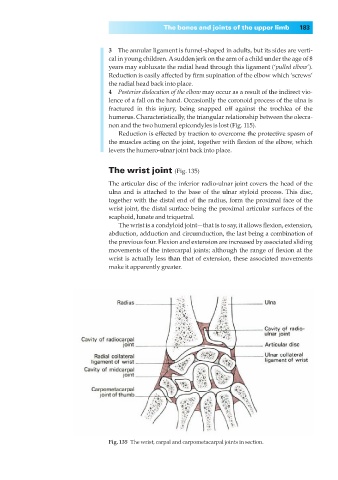
                                        The wrist joint (Fig. 135)
                                        The articular disc of the inferior radio-ulnar joint covers the head of the
                                        ulna and is attached to the base of the ulnar styloid process. This disc,
                                        together with the distal end of the radius, form the proximal face of the
                                        wrist joint, the distal surface being the proximal articular surfaces of the
                                        scaphoid, lunate and triquetral.
                                          The wrist is a condyloid joint—that is to say, it allows flexion, extension,
                                        abduction, adduction and circumduction, the last being a combination of
                                        the previous four. Flexion and extension are increased by associated sliding
                                        movements of the intercarpal joints; although the range of flexion at the
                                        wrist is actually less than that of extension, these associated movements
                                        make it apparently greater.


                                        Fig. 135◊The wrist, carpal and carpometacarpal joints in section.

