


Page 213 - Clinical Anatomy
P. 213
ECA3  7/18/06  6:45 PM  Page 198


                 198  The upper limb


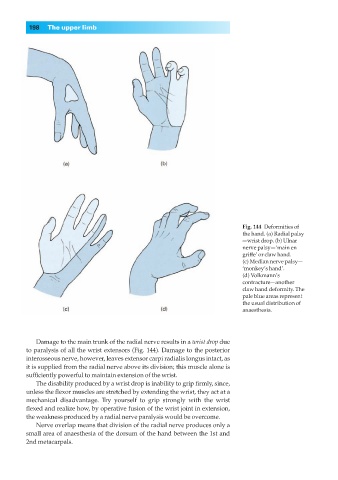
                                                                              Fig. 144◊Deformities of
                                                                              the hand. (a) Radial palsy
                                                                              —wrist drop. (b) Ulnar
                                                                              nerve palsy—‘main en
                                                                              griffe’ or claw hand.
                                                                              (c) Median nerve palsy—
                                                                              ‘monkey’s hand’.
                                                                              (d) Volkmann’s
                                                                              contracture—another
                                                                              claw hand deformity. The
                                                                              pale blue areas represent
                                                                              the usual distribution of
                                                                              anaesthesia.


                   Damage to the main trunk of the radial nerve results in a wrist drop due
                to paralysis of all the wrist extensors (Fig. 144). Damage to the posterior
                interosseous nerve, however, leaves extensor carpi radialis longus intact, as
                it is supplied from the radial nerve above its division; this muscle alone is
                sufficiently powerful to maintain extension of the wrist.
                   The disability produced by a wrist drop is inability to grip firmly, since,
                unless the flexor muscles are stretched by extending the wrist, they act at a
                mechanical disadvantage. Try yourself to grip strongly with the wrist
                flexed and realize how, by operative fusion of the wrist joint in extension,
                the weakness produced by a radial nerve paralysis would be overcome.
                   Nerve overlap means that division of the radial nerve produces only a
                small area of anaesthesia of the dorsum of the hand between the 1st and
                2nd metacarpals.

