


Page 217 - Clinical Anatomy
P. 217
ECA3  7/18/06  6:45 PM  Page 202


                 202  The upper limb


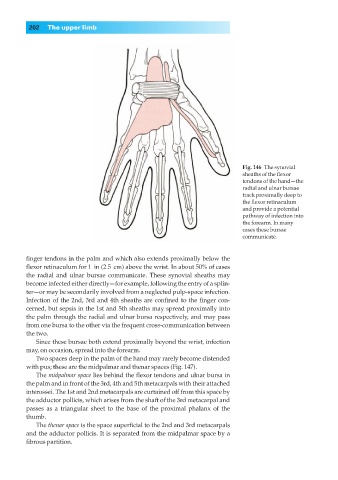
                                                                              Fig. 146◊The synovial
                                                                              sheaths of the flexor
                                                                              tendons of the hand—the
                                                                              radial and ulnar bursae
                                                                              track proximally deep to
                                                                              the flexor retinaculum
                                                                              and provide a potential
                                                                              pathway of infection into
                                                                              the forearm. In many
                                                                              cases these bursae
                                                                              communicate.

                finger tendons in the palm and which also extends proximally below the
                flexor retinaculum for 1 | in (2.5 | cm) above the wrist. In about 50% of cases
                the radial and ulnar bursae communicate. These synovial sheaths may
                become infected either directly—for example, following the entry of a splin-
                ter—or may be secondarily involved from a neglected pulp-space infection.
                Infection of the 2nd, 3rd and 4th sheaths are confined to the finger con-
                cerned, but sepsis in the 1st and 5th sheaths may spread proximally into
                the palm through the radial and ulnar bursa respectively, and may pass
                from one bursa to the other via the frequent cross-communication between
                the two.
                   Since these bursae both extend proximally beyond the wrist, infection
                may, on occasion, spread into the forearm.
                   Two spaces deep in the palm of the hand may rarely become distended
                with pus; these are the midpalmar and thenar spaces (Fig. 147).
                   The midpalmar space lies behind the flexor tendons and ulnar bursa in
                the palm and in front of the 3rd, 4th and 5th metacarpals with their attached
                interossei. The 1st and 2nd metacarpals are curtained off from this space by
                the adductor pollicis, which arises from the shaft of the 3rd metacarpal and
                passes as a triangular sheet to the base of the proximal phalanx of the
                thumb.
                   The thenar space is the space superficial to the 2nd and 3rd metacarpals
                and the adductor pollicis. It is separated from the midpalmar space by a
                fibrous partition.

