


Page 320 - Clinical Anatomy
P. 320
ECA5  7/18/06  6:51 PM  Page 305


                                                              The veins of the head and neck   305


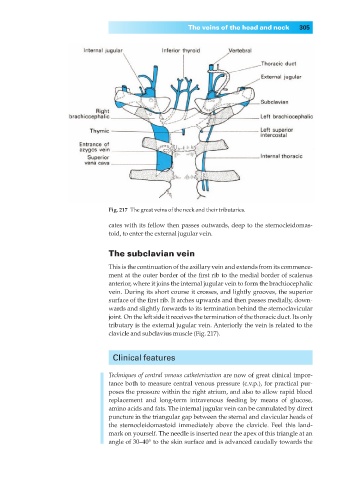
                                        Fig. 217◊The great veins of the neck and their tributaries.
                                       cates with its fellow then passes outwards, deep to the sternocleidomas-
                                       toid, to enter the external jugular vein.


                                       The subclavian vein
                                       This is the continuation of the axillary vein and extends from its commence-
                                       ment at the outer border of the first rib to the medial border of scalenus
                                       anterior, where it joins the internal jugular vein to form the brachiocephalic
                                       vein. During its short course it crosses, and lightly grooves, the superior
                                       surface of the first rib. It arches upwards and then passes medially, down-
                                       wards and slightly forwards to its termination behind the sternoclavicular
                                       joint. On the left side it receives the termination of the thoracic duct. Its only
                                       tributary is the external jugular vein. Anteriorly the vein is related to the
                                       clavicle and subclavius muscle (Fig. 217).


                                         Clinical features


                                       Techniques of central venous catheterization are now of great clinical impor-
                                       tance both to measure central venous pressure (c.v.p.), for practical pur-
                                       poses the pressure within the right atrium, and also to allow rapid blood
                                       replacement and long-term intravenous feeding by means of glucose,
                                       amino acids and fats. The internal jugular vein can be cannulated by direct
                                       puncture in the triangular gap between the sternal and clavicular heads of
                                       the sternocleidomastoid immediately above the clavicle. Feel this land-
                                       mark on yourself. The needle is inserted near the apex of this triangle at an
                                       angle of 30–40° to the skin surface and is advanced caudally towards the

