


Page 376 - Clinical Anatomy
P. 376
ECA6  7/18/06  6:54 PM  Page 361


                                                                                   The brain   361


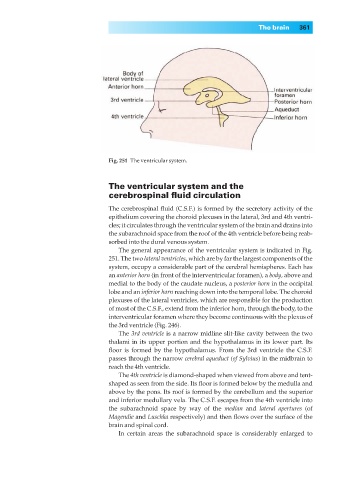
                                        Fig. 251◊The ventricular system.


                                        The ventricular system and the
                                        cerebrospinal fluid circulation

                                        The cerebrospinal fluid (C.S.F.) is formed by the secretory activity of the
                                        epithelium covering the choroid plexuses in the lateral, 3rd and 4th ventri-
                                        cles; it circulates through the ventricular system of the brain and drains into
                                        the subarachnoid space from the roof of the 4th ventricle before being reab-
                                        sorbed into the dural venous system.
                                          The general appearance of the ventricular system is indicated in Fig.
                                        251. The two lateral ventricles, which are by far the largest components of the
                                        system, occupy a considerable part of the cerebral hemispheres. Each has
                                        an anterior horn (in front of the interventricular foramen), a body, above and
                                        medial to the body of the caudate nucleus, a posterior horn in the occipital
                                        lobe and an inferior horn reaching down into the temporal lobe. The choroid
                                        plexuses of the lateral ventricles, which are responsible for the production
                                        of most of the C.S.F., extend from the inferior horn, through the body, to the
                                        interventricular foramen where they become continuous with the plexus of
                                        the 3rd ventricle (Fig. 246).
                                          The 3rd ventricle is a narrow midline slit-like cavity between the two
                                        thalami in its upper portion and the hypothalamus in its lower part. Its
                                        floor is formed by the hypothalamus. From the 3rd ventricle the C.S.F.
                                        passes through the narrow cerebral aqueduct (of Sylvius) in the midbrain to
                                        reach the 4th ventricle.
                                          The 4th ventricle is diamond-shaped when viewed from above and tent-
                                        shaped as seen from the side. Its floor is formed below by the medulla and
                                        above by the pons. Its roof is formed by the cerebellum and the superior
                                        and inferior medullary vela. The C.S.F. escapes from the 4th ventricle into
                                        the subarachnoid space by way of the  median and  lateral apertures (of
                                        Magendie and Luschka respectively) and then flows over the surface of the
                                        brain and spinal cord.
                                          In certain areas the subarachnoid space is considerably enlarged to

