


Page 10 - Critical Care Notes
P. 10
4223_Tab01_001-044  29/08/14  10:46 AM  Page 4


           BASICS

                         Pulse Oximetry
          SpO 2 monitoring may be intermittent or continuous. Indirectly monitors oxygen
          saturation.
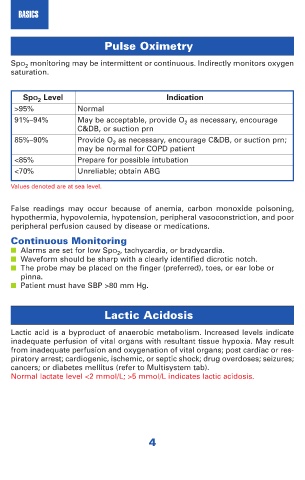
            SpO 2 Level             Indication
           >95%      Normal
           91%–94%   May be acceptable, provide O 2 as necessary, encourage
                     C&DB, or suction prn
           85%–90%   Provide O 2 as necessary, encourage C&DB, or suction prn;
                     may be normal for COPD patient
           <85%      Prepare for possible intubation
           <70%      Unreliable; obtain ABG
          Values denoted are at sea level.
          False readings may occur because of anemia, carbon monoxide poisoning,
          hypothermia, hypovolemia, hypotension, peripheral vasoconstriction, and poor
          peripheral perfusion caused by disease or medications.
          Continuous Monitoring
          ■ Alarms are set for low SpO 2 , tachycardia, or bradycardia.
          ■ Waveform should be sharp with a clearly identified dicrotic notch.
          ■ The probe may be placed on the finger (preferred), toes, or ear lobe or
            pinna.
          ■ Patient must have SBP >80 mm Hg.
                         Lactic Acidosis
          Lactic acid is a byproduct of anaerobic metabolism. Increased levels indicate
          inadequate perfusion of vital organs with resultant tissue hypoxia. May result
          from inadequate perfusion and oxygenation of vital organs; post cardiac or res-
          piratory arrest; cardiogenic, ischemic, or septic shock; drug overdoses; seizures;
          cancers; or diabetes mellitus (refer to Multisystem tab).
          Normal lactate level <2 mmol/L; >5 mmol/L indicates lactic acidosis.


                                 4

