


Page 12 - Critical Care Notes
P. 12
4223_Tab01_001-044  29/08/14  10:46 AM  Page 6


           BASICS
          ETCO 2  monitoring can also be used to verify ETT position, assess readiness for
          extubation, and monitor the effectiveness of CPR and predict patient survival.
          ETCO 2 <10 mm Hg after 20 min CPR indicates poor outcome. It is sometimes
          referred to as the “ventilation vital sign.”

              Causes of ↑ ETCO 2     Causes of ↓ ETCO 2
           Fever             Hypothermia
           Hypertension      Hypotension and shock
           Increased cardiac output  Cardiac perfusion changes
           Respiratory compromise  Decreased cardiac output, heart failure
           Hypoventilation   Cardiac arrest and apnea
           Airway obstruction   Hyperventilation
           Bronchial intubation  Airway obstruction
           Hypovolemia       Accidental extubation
           Sepsis            Pulmonary embolus
           Seizures          Hypervolemia

          Normal range of ETCO 2 is 35–45 mm Hg. CO 2 and ETCO 2 should correlate with-
           in 2–5 mm Hg.
          ↑ RR (hyperventilation) → ↓ CO 2 → ETCO 2 < 35 = respiratory alkalosis
          ↓ RR (hypoventilation) →↑ CO 2 → ETCO 2 > 45 = respiratory acidosis
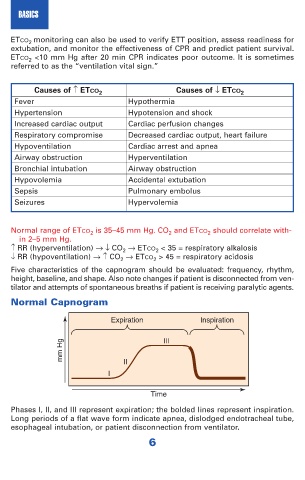
          Five characteristics of the capnogram should be evaluated: frequency, rhythm,
          height, baseline, and shape. Also note changes if patient is disconnected from ven-
          tilator and attempts of spontaneous breaths if patient is receiving paralytic agents.
          Normal Capnogram
                           Expiration    Inspiration
                  mm Hg      II    III


                          I
                                 Time
          Phases I, II, and III represent expiration; the bolded lines represent inspiration.
          Long periods of a flat wave form indicate apnea, dislodged endotracheal tube,
          esophageal intubation, or patient disconnection from ventilator.
                                 6

