


Page 158 - Critical Care Notes
P. 158
4223_Tab05_141-174  29/08/14  8:28 AM  Page 152


                                   NEURO

                         Clinical Presentation
          ■ Sudden, severe “thunderclap” headache developing over seconds to minutes.
            Patient complains of it being “the worst headache in their life” (WHOL).
          ■ Lethargy, irritability, ↓ LOC; confusion and agitation. May progress to coma.
          ■ Pain in neck or back.
          ■ Nuchal rigidity (stiff neck).
          ■ Nausea and vomiting.
          ■ Photophobia, diplopia, orbital pain, visual loss, blurred vision, and oculo-
            motor nerve abnormalities (affected eye looking downward and outward,
            pupil widened and less responsive to light) involving optic, oculomotor, or
            trigeminal cranial nerves.
          ■ Paralysis; positive Brudzinski’s sign and Kernig’s sign.
          ■ Tinnitus, dizziness, vertigo, neurological deficits including hemiparesis.
          ■ Fatigue, fever, and HTN.
          ■ Cardiac arrhythmias (can progress to cardiac arrest).
          ■ Seizures may occur early on or later.
                           Diagnostic Tests
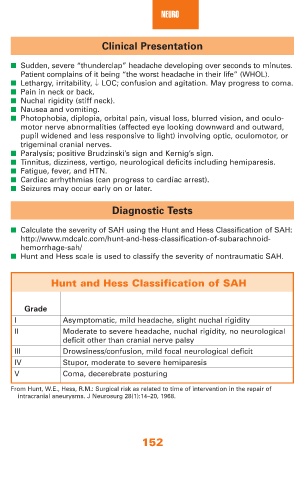
          ■ Calculate the severity of SAH using the Hunt and Hess Classification of SAH:
            http://www.mdcalc.com/hunt-and-hess-classification-of-subarachnoid-
            hemorrhage-sah/
          ■ Hunt and Hess scale is used to classify the severity of nontraumatic SAH.
                 Hunt and Hess Classification of SAH

            Grade
           I       Asymptomatic, mild headache, slight nuchal rigidity
           II      Moderate to severe headache, nuchal rigidity, no neurological
                   deficit other than cranial nerve palsy
           III     Drowsiness/confusion, mild focal neurological deficit
           IV      Stupor, moderate to severe hemiparesis
           V       Coma, decerebrate posturing
          From Hunt, W.E., Hess, R.M.: Surgical risk as related to time of intervention in the repair of
           intracranial aneurysms. J Neurosurg 28(1):14–20, 1968.


                                152

