


Page 162 - Critical Care Notes
P. 162
4223_Tab05_141-174  29/08/14  8:28 AM  Page 156


                                   NEURO
          ■ In CVA, disruption of blood flow to the brain →↓ O 2 and glucose to the
            brain → ischemic cascade → neurons unable to maintain aerobic respira-
            tion → switch to anaerobic respiration → build-up of lactic acid → change in
            blood pH → influx of intracellular calcium and increase in glutamate →
            destroys cell membrane → cell membrane and proteins break down,
            forming free radicals → cell injury and death → neurological dysfunction.
          ■ Low cerebral blood flow →↓ O 2 to the brain →↑ extraction of O 2 by
            the brain.
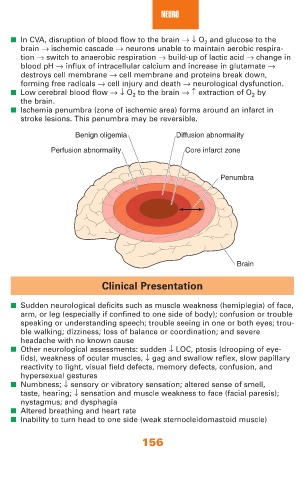
          ■ Ischemia penumbra (zone of ischemic area) forms around an infarct in
            stroke lesions. This penumbra may be reversible.
                     Benign oligemia  Diffusion abnormality
                 Perfusion abnormality  Core infarct zone
                                             Penumbra


                                               Brain

                         Clinical Presentation
          ■ Sudden neurological deficits such as muscle weakness (hemiplegia) of face,
            arm, or leg (especially if confined to one side of body); confusion or trouble
            speaking or understanding speech; trouble seeing in one or both eyes; trou-
            ble walking; dizziness; loss of balance or coordination; and severe
            headache with no known cause
          ■ Other neurological assessments: sudden ↓ LOC, ptosis (drooping of eye-
            lids), weakness of ocular muscles, ↓ gag and swallow reflex, slow papillary
            reactivity to light, visual field defects, memory defects, confusion, and
            hypersexual gestures
          ■ Numbness; ↓ sensory or vibratory sensation; altered sense of smell,
            taste, hearing; ↓ sensation and muscle weakness to face (facial paresis);
            nystagmus; and dysphagia
          ■ Altered breathing and heart rate
          ■ Inability to turn head to one side (weak sternocleidomastoid muscle)
                                156

