


Page 241 - Critical Care Notes
P. 241
4223_Tab09_230-248  29/08/14  8:26 AM  Page 235


                                235
          ■ Stimulation of the adrenal medulla → release of epinephrine and norepi-
            nephrine → cell metabolism changes from aerobic to anaerobic → lactic
            acidosis.
          ■ Cardiac hypoperfusion → ventricular failure.
          ■ Cerebral hypoperfusion → failure of sympathetic nervous system, cardiac
            and respiratory depression, and thermoregulatory failure.
          ■ Respiratory depression → ↑ pulmonary capillary membrane permeability →
            pulmonary vasoconstriction → acute respiratory failure and ARDS.
          ■ Renal hypoperfusion → acute tubular necrosis → acute renal failure.
          ■ GI hypoperfusion → failure of GI organs.
          ■ MODS is failure of two or more body systems → death.
                         Clinical Presentation

          ■ SBP <90 mm Hg. MAP <70 mm Hg and cardiac index <2.2 L/min/m 2 ,
            pulmonary wedge pressure >18 mm Hg, and systemic vascular resistance
            >1,400 dynes/sec/cm -5 in cardiogenic shock. Hypotension indicates
            >30% blood volume loss.
          ■ ↑ HR, weak and thready pulse, narrowing of pulse pressure, dysrhythmias,
            absent peripheral pulses, dysrhythmias, chest pain.
          ■ Delayed capillary refill and flat jugular veins. Distended neck veins are seen
            in cardiogenic shock.
          ■ Altered mental status, confusion, altered level of consciousness (LOC) →
            lethargy and unconsciousness or unresponsiveness.
          ■ Hypoxemia and respiratory alkalosis initially from RR and ↑ depth of respi-
            rations → respiratory distress → respiratory failure → respiratory and meta-
            bolic acidosis. Crackles or wheezing may also be present.
          ■ Oliguria progressing to anuria, and ↑ urine osmolarity and specific gravity.
            Urine is dark and concentrated.
          ■ ↑ BUN and creatinine.
          ■ Pale and cool skin progressing to ashen, cold-clammy to cyanotic, mottled,
            and diaphoretic skin.
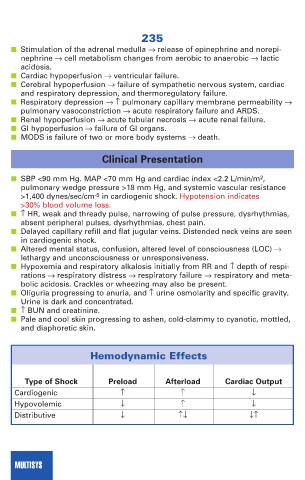
                       Hemodynamic Effects

            Type of Shock  Preload  Afterload  Cardiac Output
           Cardiogenic      ↑         ↑           ↓
           Hypovolemic      ↓         ↑           ↓
           Distributive     ↓         ↑↓         ↓↑


           MULTISYS

