


Page 247 - Critical Care Notes
P. 247
4223_Tab09_230-248  29/08/14  8:26 AM  Page 241


                                241
          ■ Calculate and monitor a Trauma Associated Severe Hemorrhage Score
            (TASH Score) for Massive Transfusion: http://www.mdcalc.com/tash-score-
            trauma-associated-severe-hemorrhage-for-massive-transfusion/
                            Complications
          ■ Hypermetabolism; occurs 24 to 48 hr after traumatic injury
          ■ Infection and sepsis; SIRS
          ■ Acute respiratory failure or ARDS
          ■ DVT; pulmonary or fat embolism
          ■ Acute renal failure
          ■ Compartment syndrome
          ■ Dilutional coagulopathy
          ■ MODS

                              Burns
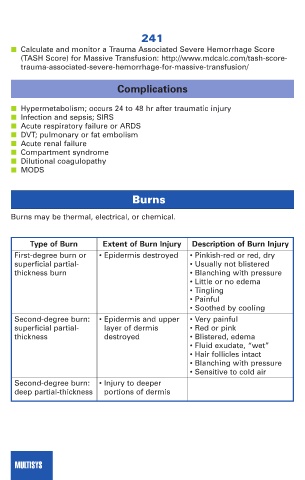
          Burns may be thermal, electrical, or chemical.

             Type of Burn  Extent of Burn Injury  Description of Burn Injury
           First-degree burn or   • Epidermis destroyed  • Pinkish-red or red, dry
           superficial partial-         • Usually not blistered
           thickness burn               • Blanching with pressure
                                        • Little or no edema
                                        • Tingling
                                        • Painful
                                        • Soothed by cooling
           Second-degree burn:  • Epidermis and upper   • Very painful
           superficial partial-  layer of dermis   • Red or pink
           thickness     destroyed      • Blistered, edema
                                        • Fluid exudate, “wet”
                                        • Hair follicles intact
                                        • Blanching with pressure
                                        • Sensitive to cold air
           Second-degree burn:  • Injury to deeper
           deep partial-thickness  portions of dermis


           MULTISYS

