


Page 248 - Critical Care Notes
P. 248
4223_Tab09_230-248  29/08/14  8:26 AM  Page 242


           MULTISYS

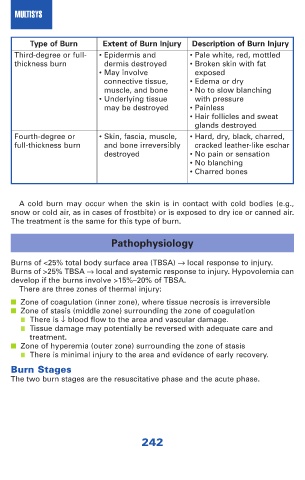
             Type of Burn  Extent of Burn Injury  Description of Burn Injury
           Third-degree or full-  • Epidermis and   • Pale white, red, mottled
           thickness burn  dermis destroyed  • Broken skin with fat
                         • May involve   exposed
                         connective tissue,   • Edema or dry
                         muscle, and bone  • No to slow blanching
                         • Underlying tissue   with pressure
                         may be destroyed  • Painless
                                        • Hair follicles and sweat
                                        glands destroyed
           Fourth-degree or   • Skin, fascia, muscle,   • Hard, dry, black, charred,
           full-thickness burn  and bone irreversibly   cracked leather-like eschar
                         destroyed      • No pain or sensation
                                        • No blanching
                                        • Charred bones
           A cold burn may occur when the skin is in contact with cold bodies (e.g.,
          snow or cold air, as in cases of frostbite) or is exposed to dry ice or canned air.
          The treatment is the same for this type of burn.
                           Pathophysiology
          Burns of <25% total body surface area (TBSA) → local response to injury.
          Burns of >25% TBSA → local and systemic response to injury. Hypovolemia can
          develop if the burns involve >15%–20% of TBSA.
           There are three zones of thermal injury:
          ■ Zone of coagulation (inner zone), where tissue necrosis is irreversible
          ■ Zone of stasis (middle zone) surrounding the zone of coagulation
            ■ There is ↓ blood flow to the area and vascular damage.
            ■ Tissue damage may potentially be reversed with adequate care and
             treatment.
          ■ Zone of hyperemia (outer zone) surrounding the zone of stasis
            ■ There is minimal injury to the area and evidence of early recovery.
          Burn Stages
          The two burn stages are the resuscitative phase and the acute phase.


                                242

