


Page 37 - Critical Care Notes
P. 37
4223_Tab01_001-044  29/08/14  10:46 AM  Page 31


                                31
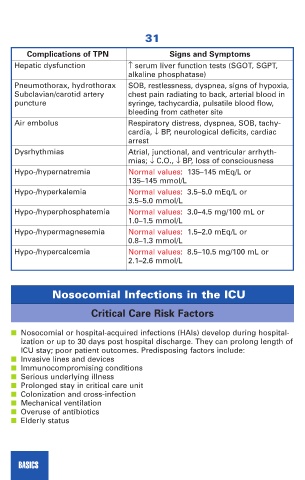
             Complications of TPN   Signs and Symptoms
           Hepatic dysfunction  ↑ serum liver function tests (SGOT, SGPT,
                             alkaline phosphatase)
           Pneumothorax, hydrothorax   SOB, restlessness, dyspnea, signs of hypoxia,
           Subclavian/carotid artery   chest pain radiating to back, arterial blood in
           puncture          syringe, tachycardia, pulsatile blood flow,
                             bleeding from catheter site
           Air embolus       Respiratory distress, dyspnea, SOB, tachy-
                             cardia, ↓ BP, neurological deficits, cardiac
                             arrest
           Dysrhythmias      Atrial, junctional, and ventricular arrhyth-
                             mias; ↓ C.O., ↓ BP, loss of consciousness
           Hypo-/hypernatremia  Normal values:  135–145 mEq/L or
                             135–145 mmol/L
           Hypo-/hyperkalemia  Normal values:  3.5–5.0 mEq/L or
                             3.5–5.0 mmol/L
           Hypo-/hyperphosphatemia  Normal values:  3.0–4.5 mg/100 mL or
                             1.0–1.5 mmol/L
           Hypo-/hypermagnesemia  Normal values:  1.5–2.0 mEq/L or
                             0.8–1.3 mmol/L
           Hypo-/hypercalcemia  Normal values:  8.5–10.5 mg/100 mL or
                             2.1–2.6 mmol/L

                 Nosocomial Infections in the ICU
                       Critical Care Risk Factors
          ■ Nosocomial or hospital-acquired infections (HAIs) develop during hospital-
            ization or up to 30 days post hospital discharge. They can prolong length of
            ICU stay; poor patient outcomes. Predisposing factors include:
          ■ Invasive lines and devices
          ■ Immunocompromising conditions
          ■ Serious underlying illness
          ■ Prolonged stay in critical care unit
          ■ Colonization and cross-infection
          ■ Mechanical ventilation
          ■ Overuse of antibiotics
          ■ Elderly status


           BASICS

