


Page 36 - Critical Care Notes
P. 36
4223_Tab01_001-044  29/08/14  10:46 AM  Page 30


           BASICS
          Indications
          ■ Severe malnutrition
          ■ Burns
          ■ Bowel disorders (inflammatory disorders, total bowel obstruction, short
            bowel syndrome)
          ■ Severe acute pancreatitis
          ■ Acute renal failure
          ■ Hepatic failure
          ■ Metastatic cancer
          ■ Postoperative major surgery if NPO >5 days
          Nursing Care
          ■ Each bag of TPN should be changed at least every 24 hr with tubing change.
          ■ Monitor intake and output and weigh the patient daily.
          ■ Monitor glucose levels, including finger stick blood sugars every 4 to 6 hr.
            Cover with regular insulin as necessary. If poor control of serum glucose,
            consider adding insulin to TPN and continue sliding scale coverage.
          ■ Monitor serum electrolytes including magnesium, phosphate, triglycerides,
            prealbumin, transferrin, CBC, PT/PTT, and urine urea nitrogen.
          ■ Assess IV site for redness, swelling, and drainage.
          ■ Change gauze dressing around IV site every 48 to 72 hr, as per protocol.
            Transparent dressings may be changed every 7 days.
          ■ If TPN is temporarily unavailable, hang 10% D/W at the same rate as TPN.
            Monitor for hypoglycemia.
          ■ Place TPN on infusion pump. Monitor hourly rate. Never attempt to “catch
            up” if infusion not accurate.
          Complications
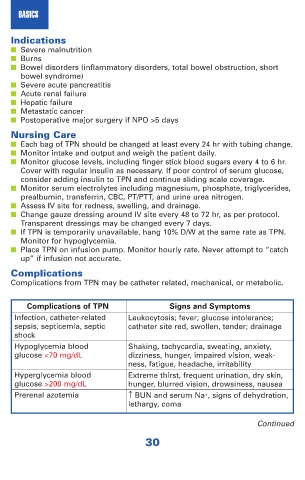
          Complications from TPN may be catheter related, mechanical, or metabolic.
             Complications of TPN   Signs and Symptoms
           Infection, catheter-related   Leukocytosis; fever; glucose intolerance;
           sepsis, septicemia, septic   catheter site red, swollen, tender; drainage
           shock
           Hypoglycemia blood   Shaking, tachycardia, sweating, anxiety,
           glucose <70 mg/dL  dizziness, hunger, impaired vision, weak-
                             ness, fatigue, headache, irritability
           Hyperglycemia blood   Extreme thirst, frequent urination, dry skin,
           glucose >200 mg/dL  hunger, blurred vision, drowsiness, nausea
           Prerenal azotemia  ↑ BUN and serum Na + , signs of dehydration,
                             lethargy, coma
                                                   Continued
                                30

