


Page 119 - Clinical Application of Mechanical Ventilation
P. 119
Operating Modes of Mechanical Ventilation  85


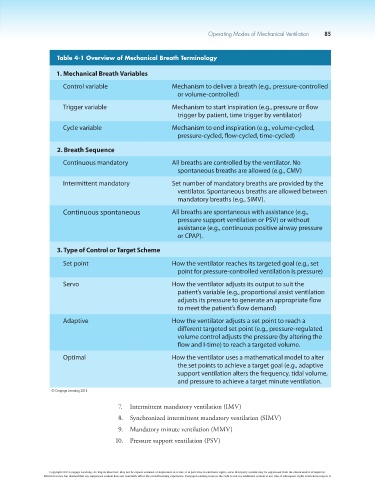
                          Table 4-1 Overview of Mechanical Breath Terminology

                          1. Mechanical Breath Variables

                            Control variable                    Mechanism to deliver a breath (e.g., pressure-controlled
                                                                  or volume-controlled)
                            Trigger variable                    Mechanism to start inspiration (e.g., pressure or flow
                                                                  trigger by patient, time trigger by ventilator)
                            Cycle variable                      Mechanism to end inspiration (e.g., volume-cycled,
                                                                  pressure-cycled, flow-cycled, time-cycled)

                          2. Breath Sequence
                            Continuous mandatory                All breaths are controlled by the ventilator. No
                                                                  spontaneous breaths are allowed (e.g., CMV)

                            Intermittent mandatory              Set number of mandatory breaths are provided by the
                                                                  ventilator. Spontaneous breaths are allowed between
                                                                  mandatory breaths (e.g., SIMV).
                            Continuous spontaneous              All breaths are spontaneous with assistance (e.g.,
                                                                  pressure support ventilation or PSV) or without
                                                                  assistance (e.g., continuous positive airway pressure
                                                                  or CPAP).

                          3.  Type of Control or Target Scheme

                            Set point                           How the ventilator reaches its targeted goal (e.g., set
                                                                  point for pressure-controlled ventilation is pressure)
                            Servo                               How the ventilator adjusts its output to suit the
                                                                  patient’s variable (e.g., proportional assist ventilation
                                                                  adjusts its pressure to generate an appropriate flow
                                                                  to meet the patient’s flow demand)

                            Adaptive                            How the ventilator adjusts a set point to reach a
                                                                  different targeted set point (e.g., pressure-regulated
                                                                  volume control adjusts the pressure (by altering the
                                                                  flow and I-time) to reach a targeted volume.
                            Optimal                             How the ventilator uses a mathematical model to alter
                                                                  the set points to achieve a target goal (e.g., adaptive
                                                                  support ventilation alters the frequency, tidal volume,
                                                                  and pressure to achieve a target minute ventilation.
                        © Cengage Learning 2014

                                              7.  Intermittent mandatory ventilation (IMV)
                                              8.  Synchronized intermittent mandatory ventilation (SIMV)

                                              9.  Mandatory minute ventilation (MMV)
                                             10.  Pressure support ventilation (PSV)


                        Copyright 2013 Cengage Learning. All Rights Reserved. May not be copied, scanned, or duplicated, in whole or in part. Due to electronic rights, some third party content may be suppressed from the eBook and/or eChapter(s).
                      Editorial review has deemed that any suppressed content does not materially affect the overall learning experience. Cengage Learning reserves the right to remove additional content at any time if subsequent rights restrictions require it.

