


Page 122 - Clinical Application of Mechanical Ventilation
P. 122
88     Chapter 4


                                                    60
                                                  Airway Pressure (cm H 2 O)  40
                                                    50


                                                    30
                                                    20
                                                    10
                                                     0

                                                   –10             A           B                            © Cengage Learning 2014

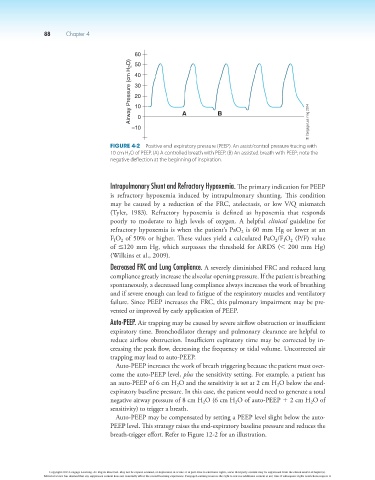
                                            Figure 4-2  Positive end-expiratory pressure (PEEP). An assist/control pressure tracing with
                                            10 cm H 2 O of PEEP. (A) A controlled breath with PEEP. (B) An assisted breath with PEEP; note the
                                            negative deflection at the beginning of inspiration.


                                            Intrapulmonary Shunt and Refractory Hypoxemia. The primary indication for PEEP
                                            is  refractory  hypoxemia  induced  by  intrapulmonary  shunting.  This  condition
                                            may  be  caused  by  a  reduction  of the  FRC, atelectasis, or  low  V/Q  mismatch
                                            (Tyler,  1983).  Refractory  hypoxemia  is  defined  as  hypoxemia  that  responds
                                            poorly  to  moderate  to  high  levels  of  oxygen.  A  helpful  clinical  guideline  for
                                            refractory hypoxemia is when the patient’s PaO  is 60 mm Hg or lower at an
                                                                                      2
                                            F O  of 50% or higher. These values yield a calculated PaO /F O  (P/F) value
                                             I
                                                                                                      2
                                                                                                    I
                                                                                                 2
                                               2
                                            of #120 mm Hg, which surpasses the threshold for ARDS (, 200 mm Hg)
                                            (Wilkins et al., 2009).
                                            Decreased FRC and Lung Compliance. A severely diminished FRC and reduced lung
                                            compliance greatly increase the alveolar opening pressure. If the patient is breathing
                                            spontaneously, a decreased lung compliance always increases the work of breathing
                                            and if severe enough can lead to fatigue of the respiratory muscles and ventilatory
                                            failure. Since PEEP increases the FRC, this pulmonary impairment may be pre-
                                            vented or improved by early application of PEEP.
                                            Auto-PEEP. Air trapping may be caused by severe airflow obstruction or insufficient
                                            expiratory time. Bronchodilator therapy and pulmonary clearance are helpful to
                                            reduce airflow obstruction. Insufficient expiratory time may be corrected by in-
                                            creasing the peak flow, decreasing the frequency or tidal volume. Uncorrected air
                                            trapping may lead to auto-PEEP.
                                             Auto-PEEP increases the work of breath triggering because the patient must over-
                                            come the auto-PEEP level, plus the sensitivity setting. For example, a patient has
                                            an auto-PEEP of 6 cm H O and the sensitivity is set at 2 cm H O below the end-
                                                                 2
                                                                                                  2
                                            expiratory baseline pressure. In this case, the patient would need to generate a total
                                            negative airway pressure of 8 cm H O (6 cm H O of auto-PEEP 1 2 cm H O of
                                                                                    2
                                                                                                             2
                                                                          2
                                            sensitivity) to trigger a breath.
                                             Auto-PEEP may be compensated by setting a PEEP level slight below the auto-
                                            PEEP level. This strategy raises the end-expiratory baseline pressure and reduces the
                                            breath-trigger effort. Refer to Figure 12-2 for an illustration.


                        Copyright 2013 Cengage Learning. All Rights Reserved. May not be copied, scanned, or duplicated, in whole or in part. Due to electronic rights, some third party content may be suppressed from the eBook and/or eChapter(s).
                      Editorial review has deemed that any suppressed content does not materially affect the overall learning experience. Cengage Learning reserves the right to remove additional content at any time if subsequent rights restrictions require it.

