


Page 121 - Clinical Application of Mechanical Ventilation
P. 121
Operating Modes of Mechanical Ventilation  87


                                                     60
                                                     50
                                                    Airway Pressure (cm H 2 O)  40  A          B


                                                     30
                                                     20
                                                     10
                                                                                                              © Cengage Learning 2014
                                                      0

                                                    –10

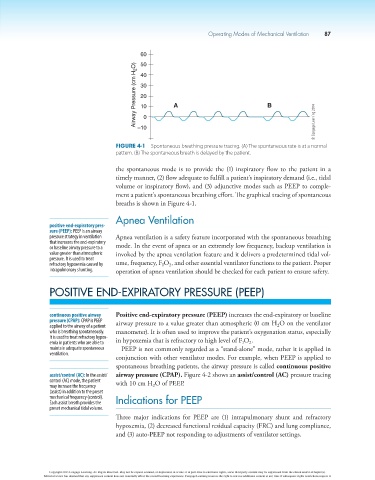
                                             Figure 4-1  Spontaneous breathing pressure tracing. (A) The spontaneous rate is at a normal
                                             pattern. (B) The spontaneous breath is delayed by the patient.

                                             the spontaneous mode is to provide the (1) inspiratory flow to the patient in a
                                             timely manner, (2) flow adequate to fulfill a patient’s inspiratory demand (i.e., tidal
                                             volume or inspiratory flow), and (3) adjunctive modes such as PEEP to comple-
                                             ment a patient’s spontaneous breathing effort. The graphical tracing of spontaneous
                                             breaths is shown in Figure 4-1.

                                             Apnea Ventilation
                        positive end-expiratory pres-
                        sure (PEEP): PEEP is an airway
                        pressure strategy in ventilation   Apnea ventilation is a safety feature incorporated with the spontaneous breathing
                        that increases the end-expiratory
                        or baseline airway pressure to a   mode. In the event of apnea or an extremely low frequency, backup ventilation is
                        value greater than atmospheric   invoked by the apnea ventilation feature and it delivers a predetermined tidal vol-
                        pressure. It is used to treat
                        refractory hypoxemia caused by   ume, frequency, F O , and other essential ventilator functions to the patient. Proper
                                                             I
                                                               2
                        intrapulmonary shunting.  operation of apnea ventilation should be checked for each patient to ensure safety.
                        POSITIVE END-EXPIRATORY PRESSURE (PEEP)


                        continuous positive airway   Positive end-expiratory pressure (PEEP) increases the end-expiratory or baseline
                        pressure (CPAP): CPAP is PEEP   airway pressure to a value greater than atmospheric (0 cm H O on the ventilator
                        applied to the airway of a patient                                        2
                        who is breathing spontaneously.   manometer). It is often used to improve the patient’s oxygenation status, especially
                        It is used to treat refractory hypox-
                        emia in patients who are able to   in hypoxemia that is refractory to high level of F O .
                                                                                       I
                                                                                         2
                        maintain adequate spontaneous   PEEP is not commonly regarded as a “stand-alone” mode, rather it is applied in
                        ventilation.
                                             conjunction with other ventilator modes. For example, when PEEP is applied to
                                             spontaneous breathing patients, the airway pressure is called continuous positive
                        assist/control (AC): In the assist/  airway pressure (CPAP). Figure 4-2 shows an assist/control (AC) pressure tracing
                        control (AC) mode, the patient   with 10 cm H O of PEEP.
                        may increase the frequency       2
                        (assist) in addition to the preset
                        mechanical frequency (control).   Indications for PEEP
                        Each assist breath provides the
                        preset mechanical tidal volume.
                                             Three  major  indications  for  PEEP  are  (1)  intrapulmonary  shunt  and  refractory
                                             hypoxemia, (2) decreased functional residual capacity (FRC) and lung compliance,
                                             and (3) auto-PEEP not responding to adjustments of ventilator settings.


                        Copyright 2013 Cengage Learning. All Rights Reserved. May not be copied, scanned, or duplicated, in whole or in part. Due to electronic rights, some third party content may be suppressed from the eBook and/or eChapter(s).
                      Editorial review has deemed that any suppressed content does not materially affect the overall learning experience. Cengage Learning reserves the right to remove additional content at any time if subsequent rights restrictions require it.

