


Page 187 - Clinical Application of Mechanical Ventilation
P. 187
Airway Management in Mechanical Ventilation  153


                                             provides closer access to the lower airways. It has a lower mechanical deadspace
                                             volume than an ET tube. It also ventilates the patient more efficiently and en-
                                             hances secretion removal. In spite of many advantages of a tracheostomy tube,
                                             ET intubation is preferred as the initial means of establishing an artificial airway.
                                               Oral and nasal intubations are commonly done by respiratory care practitioners.
                                             When these two routes are not accessible or when the need for a long-term artificial
                                             airway is expected, a tracheotomy is done by a physician who is proficient in this
                                             surgical procedure.


                                             Indications


                                             The decision to perform ET intubation versus tracheotomy is based on the expected
                                             duration of need. In general, if the patient requires an artificial airway for a brief
                                             period (e.g., 10 days or less) and full recovery is expected, an ET tube is used. On
                                             the other hand, if the patient’s condition is critical and recovery is not expected
                                             any time soon (e.g., more than 21 days), a tracheostomy tube is preferred (Shapiro
                                             et al., 1991).
                                               Choosing when to intubate is also a difficult clinical decision because delayed
                                             intubation may lead to hypoventilation, hypoxemia, and hypoxia. The timing of in-
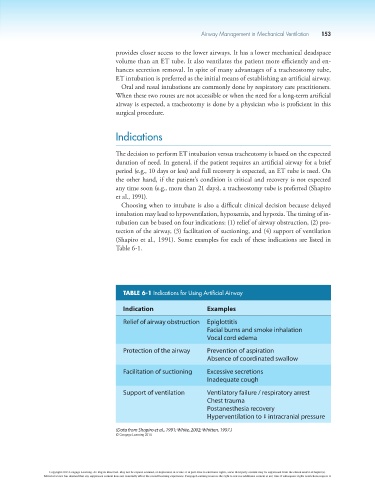
                                             tubation can be based on four indications: (1) relief of airway obstruction, (2) pro-
                                             tection of the airway, (3) facilitation of suctioning, and (4) support of ventilation
                                             (Shapiro et al., 1991). Some examples for each of these indications are listed in
                                             Table 6-1.


                                                TABLE 6-1 Indications for Using Artificial Airway

                                                Indication                 Examples

                                                Relief of airway obstruction  Epiglottitis
                                                                           Facial burns and smoke inhalation
                                                                           Vocal cord edema

                                                Protection of the airway   Prevention of aspiration
                                                                           Absence of coordinated swallow

                                                Facilitation of suctioning  Excessive secretions
                                                                           Inadequate cough
                                                Support of ventilation     Ventilatory failure / respiratory arrest
                                                                           Chest trauma
                                                                           Postanesthesia recovery
                                                                           Hyperventilation to   intracranial pressure
                                                                                              ➞
                                             (Data from Shapiro et al., 1991; White, 2002; Whitten, 1997.)
                                             © Cengage Learning 2014


                        Copyright 2013 Cengage Learning. All Rights Reserved. May not be copied, scanned, or duplicated, in whole or in part. Due to electronic rights, some third party content may be suppressed from the eBook and/or eChapter(s).
                      Editorial review has deemed that any suppressed content does not materially affect the overall learning experience. Cengage Learning reserves the right to remove additional content at any time if subsequent rights restrictions require it.

