


Page 188 - Clinical Application of Mechanical Ventilation
P. 188
154    Chapter 6


                      COMMON ARTIFICIAL AIRWAYS IN
                      MECHANICAL VENTILATION


                                            An ET tube may be inserted orally (oral intubation) or nasally (nasal intubation)
                          Oral intubation is easy to   through the larynx into the trachea. Oral intubation is easy to perform and it is
                        perform and is often done in
                        emergency situations.  often done in emergency situations. Nasal intubation is more time-consuming and
                                            it is more suitable in elective intubations.
                                             Some ET tubes (e.g., Spiral-Flex®) are reinforced with spiral stainless steel wire
                                            within the tube wall to reduce risk of tube kinking. They are the ideal choice for
                                            head and neck surgery when bending or compression of the tube is likely to occur, or
                                            for patients in the ICU biting on the tube or experiencing seizures. These tubes are
                                            part metal and must be replaced with a regular ET tube when the patient undergoes
                                            any procedure involving magnetic resonance imaging.


                                            Endotracheal Tube


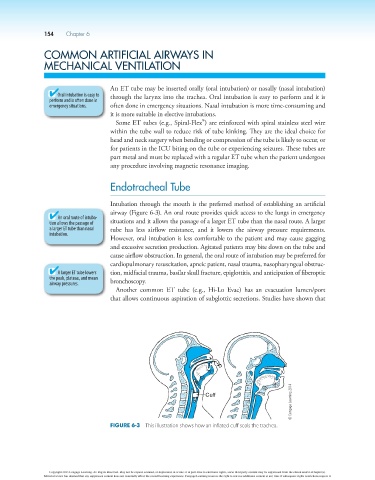
                                            Intubation through the mouth is the preferred method of establishing an artificial
                                            airway (Figure 6-3). An oral route provides quick access to the lungs in emergency
                          An oral route of intuba-
                        tion allows the passage of   situations and it allows the passage of a larger ET tube than the nasal route. A larger
                        a larger ET tube than nasal   tube  has  less  airflow  resistance,  and  it  lowers  the  airway  pressure  requirements.
                        intubation.
                                            However, oral intubation is less comfortable to the patient and may cause gagging
                                            and excessive secretion production. Agitated patients may bite down on the tube and
                                            cause airflow obstruction. In general, the oral route of intubation may be preferred for
                                            cardiopulmonary resuscitation, apneic patient, nasal trauma, nasopharyngeal obstruc-
                          A larger ET tube lowers   tion, midfacial trauma, basilar skull fracture, epiglottitis, and anticipation of fiberoptic
                        the peak, plateau, and mean
                        airway pressures.   bronchoscopy.
                                             Another  common  ET  tube  (e.g.,  Hi-Lo  Evac)  has  an  evacuation  lumen/port
                                            that allows continuous aspiration of subglottic secretions. Studies have shown that


                                                                                                       © Cengage Learning 2014


                                            Figure 6-3  This illustration shows how an inflated cuff seals the trachea.


                        Copyright 2013 Cengage Learning. All Rights Reserved. May not be copied, scanned, or duplicated, in whole or in part. Due to electronic rights, some third party content may be suppressed from the eBook and/or eChapter(s).
                      Editorial review has deemed that any suppressed content does not materially affect the overall learning experience. Cengage Learning reserves the right to remove additional content at any time if subsequent rights restrictions require it.

