


Page 192 - Clinical Application of Mechanical Ventilation
P. 192
158    Chapter 6


                                                                                                            © itsjustme/www.Shutterstock.com
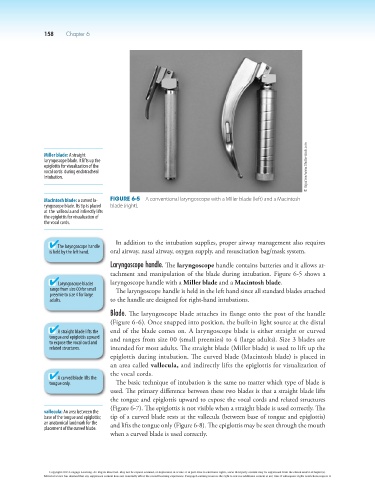
                      Miller blade: A straight
                      laryngoscope blade. It lifts up the
                      epiglottis for visualization of the
                      vocal cords  during endotracheal
                      intubation.


                      MacIntosh blade: a curved la-  Figure 6-5  A conventional laryngoscope with a Miller blade (left) and a Macintosh
                      ryngoscope blade. Its tip is placed   blade (right).
                      at  the  vallecula and indirectly lifts
                      the epiglottis for visualization of
                      the vocal cords.


                                             In addition to the intubation supplies, proper airway management also requires
                          The laryngoscope handle
                        is held by the left hand.  oral airway, nasal airway, oxygen supply, and resuscitation bag/mask system.
                                            Laryngoscope handle. The laryngoscope handle contains batteries and it allows at-
                                            tachment and manipulation of the blade during intubation. Figure 6-5 shows a
                           Laryngoscope blades   laryngoscope handle with a Miller blade and a Macintosh blade.
                        range from size 00 for small   The laryngoscope handle is held in the left hand since all standard blades attached
                        preemie to size 4 for large
                        adults.             to the handle are designed for right-hand intubations.
                                            Blade. The laryngoscope blade attaches its flange onto the post of the handle
                                            (Figure 6-6). Once snapped into position, the built-in light source at the distal
                          A straight blade lifts the   end of the blade comes on. A laryngoscope blade is either straight or curved
                        tongue and epiglottis upward   and ranges from size 00 (small preemies) to 4 (large adults). Size 3 blades are
                        to expose the vocal cord and
                        related structures.  intended for most adults. The straight blade (Miller blade) is used to lift up the
                                            epiglottis during intubation. The curved blade (Macintosh blade) is placed in
                                            an area called vallecula, and indirectly lifts the epiglottis for visualization of
                                            the vocal cords.
                          A curved blade lifts the
                        tongue only.         The basic technique of intubation is the same no matter which type of blade is
                                            used. The primary difference between these two blades is that a straight blade lifts
                                            the tongue and epiglottis upward to expose the vocal cords and related structures
                                            (Figure 6-7). The epiglottis is not visible when a straight blade is used correctly. The
                      vallecula: An area between the
                      base of the tongue and epiglottis;   tip of a curved blade rests at the vallecula (between base of tongue and epiglottis)
                      an anatomical landmark for the   and lifts the tongue only (Figure 6-8). The epiglottis may be seen through the mouth
                      placement of the curved blade.
                                            when a curved blade is used correctly.


                        Copyright 2013 Cengage Learning. All Rights Reserved. May not be copied, scanned, or duplicated, in whole or in part. Due to electronic rights, some third party content may be suppressed from the eBook and/or eChapter(s).
                      Editorial review has deemed that any suppressed content does not materially affect the overall learning experience. Cengage Learning reserves the right to remove additional content at any time if subsequent rights restrictions require it.

