


Page 220 - Clinical Application of Mechanical Ventilation
P. 220
186    Chapter 6


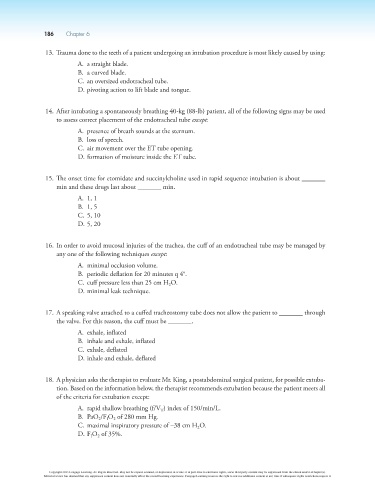
                       13. Trauma done to the teeth of a patient undergoing an intubation procedure is most likely caused by using:
                                 A.  a straight blade.
                                 B.  a curved blade.
                                 C.  an oversized endotracheal tube.
                                 D. pivoting action to lift blade and tongue.


                       14. After intubating a spontaneously breathing 40-kg (88-lb) patient, all of the following signs may be used
                          to assess correct placement of the endotracheal tube except:
                                 A.  presence of breath sounds at the sternum.
                                 B.  loss of speech.
                                 C.  air movement over the ET tube opening.
                                 D. formation of moisture inside the ET tube.


                       15. The onset time for etomidate and succinylcholine used in rapid sequence intubation is about _______
                          min and these drugs last about _______ min.

                                 A.  1, 1
                                 B.  1, 5
                                 C.  5, 10
                                 D. 5, 20


                       16. In order to avoid mucosal injuries of the trachea, the cuff of an endotracheal tube may be managed by
                          any one of the following techniques except:
                                 A.  minimal occlusion volume.
                                 B.  periodic deflation for 20 minutes q 4°.
                                 C.  cuff pressure less than 25 cm H O.
                                                               2
                                 D. minimal leak technique.


                       17. A speaking valve attached to a cuffed tracheostomy tube does not allow the patient to _______ through
                          the valve. For this reason, the cuff must be _______.
                                 A.  exhale, inflated
                                 B.  inhale and exhale, inflated
                                 C.  exhale, deflated
                                 D. inhale and exhale, deflated


                       18. A physician asks the therapist to evaluate Mr. King, a postabdominal surgical patient, for possible extuba-
                          tion. Based on the information below, the therapist recommends extubation because the patient meets all
                          of the criteria for extubation except:
                                 A.  rapid shallow breathing (f/V ) index of 150/min/L.
                                                            T
                                 B.  PaO /F O  of 280 mm Hg.
                                        2
                                             2
                                          I
                                 C.  maximal inspiratory pressure of –38 cm H O.
                                                                        2
                                 D. F O  of 35%.
                                     I
                                       2


                        Copyright 2013 Cengage Learning. All Rights Reserved. May not be copied, scanned, or duplicated, in whole or in part. Due to electronic rights, some third party content may be suppressed from the eBook and/or eChapter(s).
                      Editorial review has deemed that any suppressed content does not materially affect the overall learning experience. Cengage Learning reserves the right to remove additional content at any time if subsequent rights restrictions require it.

