


Page 215 - Clinical Application of Mechanical Ventilation
P. 215
Airway Management in Mechanical Ventilation  181


                                               Vital signs, blood gases, and signs of tissue damage should be assessed carefully after
                            Aspiration, laryngo-  extubation. Some immediate postextubation complications include aspiration, laryngo-
                          spasm, hoarseness, and
                          laryngeal and subglottic   spasm, hoarseness, and laryngeal and subglottic edema. Other more severe complications
                          edema are some complica-
                          tions immediately after   that may not be immediately apparent are mucosal injuries, laryngeal stenosis, tracheal
                          extubation.        inflammation, dilation or stenosis, and vocal cord paralysis (Young et al., 1995).


                                             Unplanned Extubation


                                             Unplanned extubation or inadvertent extubation (self-inflicted or accidental) ac-
                        unplanned extubation: Unex-
                        pected removal of an endotracheal   counts for about 8% to 10% of all extubations in ICU patients (Listello et al.,
                        or tracheostomy tube before the   1994). For patients who self-extubate the endotracheal tube, about 50% of them
                        patient is ready for extubation.
                                             do not need to be reintubated (Betbese et al., 1998; Chevron et al., 1998). Whether
                                             or not to reintubate the patient can be a difficult decision. Delayed reintubation
                                             may lead to adverse outcomes such as hypoventilation, hypoxemia, and hypoxia.
                                             In general, the decision to reintubate may be based on clinical observations and
                                             the criteria for extubation (i.e., rapid shallow breathing index, blood gases, ventila-
                                             tory reserve, and general cardiopulmonary signs). However, these measurements
                                             may not have been done immediately before extubation since the extubation is not
                                             planned.
                                               To avoid this problem, other criteria based on routinely available patient in-
                                             formation  have  been  identified  and  used  for  the  reintubation  decision.  They
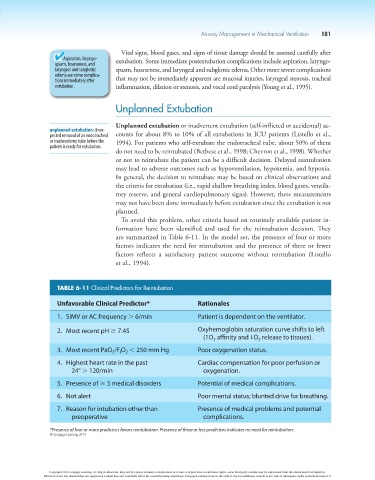
                                             are summarized in Table 6-11. In the model set, the presence of four or more
                                             factors indicates the need for reintubation and the presence of three or fewer
                                             factors  reflects  a  satisfactory  patient  outcome  without  reintubation  (Listello
                                             et al., 1994).


                          TABLE 6-11 Clinical Predictors for Reintubation

                          Unfavorable Clinical Predictor*               Rationales

                          1.  SIMV or AC frequency . 6/min              Patient is dependent on the ventilator.

                          2.  Most recent pH $ 7.45                     Oxyhemoglobin saturation curve shifts to left
                                                                          ( ➞  O  affinity and  O  release to tissues).
                                                                                            2
                                                                             2
                                                                                         ➞
                          3.  Most recent PaO /F O  , 250 mm Hg         Poor oxygenation status.
                                            2
                                               I
                                                 2
                          4.   Highest heart rate in the past           Cardiac compensation for poor perfusion or
                                24° . 120/min                             oxygenation.
                          5.  Presence of $ 3 medical disorders         Potential of medical complications.
                          6.  Not alert                                 Poor mental status; blunted drive for breathing.

                          7.   Reason for intubation other than         Presence of medical problems and potential
                                preoperative                              complications.

                        *Presence of four or more predictors favors reintubation. Presence of three or less predictors indicates no need for reintubation.
                        © Cengage Learning 2014


                        Copyright 2013 Cengage Learning. All Rights Reserved. May not be copied, scanned, or duplicated, in whole or in part. Due to electronic rights, some third party content may be suppressed from the eBook and/or eChapter(s).
                      Editorial review has deemed that any suppressed content does not materially affect the overall learning experience. Cengage Learning reserves the right to remove additional content at any time if subsequent rights restrictions require it.

