


Page 216 - Clinical Application of Mechanical Ventilation
P. 216
182    Chapter 6


                      COMPLICATIONS OF ENDOTRACHEAL AIRWAY


                                            Endotracheal intubation is an extremely useful procedure in the establishment of
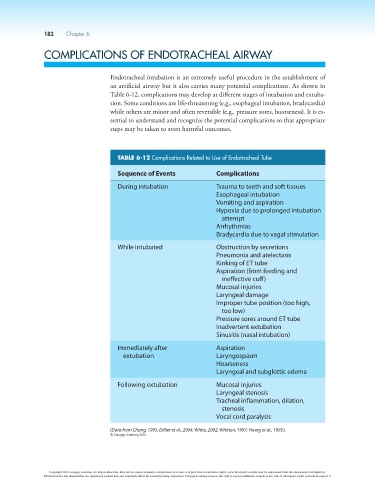
                                            an artificial airway but it also carries many potential complications. As shown in
                                            Table 6-12, complications may develop at different stages of intubation and extuba-
                                            tion. Some conditions are life-threatening (e.g., esophageal intubation, bradycardia)
                                            while others are minor and often reversible (e.g., pressure sores, hoarseness). It is es-
                                            sential to understand and recognize the potential complications so that appropriate
                                            steps may be taken to avert harmful outcomes.


                                              TABLE 6-12 Complications Related to Use of Endotracheal Tube

                                              Sequence of Events              Complications
                                              During intubation               Trauma to teeth and soft tissues
                                                                              Esophageal intubation
                                                                              Vomiting and aspiration
                                                                              Hypoxia due to prolonged intubation
                                                                                attempt
                                                                              Arrhythmias
                                                                              Bradycardia due to vagal stimulation

                                              While intubated                 Obstruction by secretions
                                                                              Pneumonia and atelectasis
                                                                              Kinking of ET tube
                                                                              Aspiration (from feeding and
                                                                                ineffective cuff)
                                                                              Mucosal injuries
                                                                              Laryngeal damage
                                                                              Improper tube position (too high,
                                                                                too low)
                                                                              Pressure sores around ET tube
                                                                              Inadvertent extubation
                                                                              Sinusitis (nasal intubation)
                                              Immediately after               Aspiration
                                                extubation                    Laryngospasm
                                                                              Hoarseness
                                                                              Laryngeal and subglottic edema

                                              Following extubation            Mucosal injuries
                                                                              Laryngeal stenosis
                                                                              Tracheal inflammation, dilation,
                                                                                stenosis
                                                                              Vocal cord paralysis

                                            (Data from Chang, 1995; Dillier et al., 2004; White, 2002; Whitten, 1997; Young et al., 1995.)
                                            © Cengage Learning 2014


                        Copyright 2013 Cengage Learning. All Rights Reserved. May not be copied, scanned, or duplicated, in whole or in part. Due to electronic rights, some third party content may be suppressed from the eBook and/or eChapter(s).
                      Editorial review has deemed that any suppressed content does not materially affect the overall learning experience. Cengage Learning reserves the right to remove additional content at any time if subsequent rights restrictions require it.

