


Page 229 - Clinical Application of Mechanical Ventilation
P. 229
Noninvasive Positive Pressure Ventilation  195


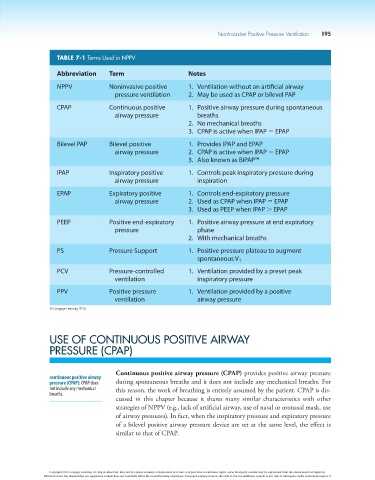
                          TABLE 7-1 Terms Used in NPPV

                          Abbreviation     Term                      Notes

                          NPPV             Noninvasive positive      1.  Ventilation without an artificial airway
                                             pressure ventilation    2.  May be used as CPAP or bilevel PAP
                          CPAP             Continuous positive       1.   Positive airway pressure during spontaneous
                                             airway pressure             breaths
                                                                     2.  No mechanical breaths
                                                                     3.  CPAP is active when IPAP 5 EPAP

                          Bilevel PAP      Bilevel positive          1.  Provides IPAP and EPAP
                                             airway pressure         2.  CPAP is active when IPAP 5 EPAP
                                                                     3.  Also known as BiPAP™
                          IPAP             Inspiratory positive      1.   Controls peak inspiratory pressure during
                                             airway pressure             inspiration

                          EPAP             Expiratory positive       1.  Controls end-expiratory pressure
                                             airway pressure         2.  Used as CPAP when IPAP 5 EPAP
                                                                     3.  Used as PEEP when IPAP . EPAP

                          PEEP             Positive end-expiratory   1.   Positive airway pressure at end expiratory
                                             pressure                   phase
                                                                     2.  With mechanical breaths
                          PS               Pressure Support          1.   Positive pressure plateau to augment
                                                                         spontaneous V T

                          PCV              Pressure-controlled       1.   Ventilation provided by a preset peak
                                             ventilation                inspiratory pressure

                          PPV              Positive pressure         1.   Ventilation provided by a positive
                                             ventilation                airway pressure

                        © Cengage Learning 2014


                        USE Of CONTINUOUS POSITIVE AIRwAy
                        PRESSURE (CPAP)


                                             Continuous positive airway pressure (CPAP) provides positive airway pressure
                        continuous positive airway
                        pressure (CPAP): CPAP does   during spontaneous breaths and it does not include any mechanical breaths. For
                        not include any mechanical   this reason, the work of breathing is entirely assumed by the patient. CPAP is dis-
                        breaths.
                                             cussed in this chapter because it shares many similar characteristics with other
                                             strategies of NPPV (e.g., lack of artificial airway, use of nasal or oronasal mask, use
                                             of airway pressures). In fact, when the inspiratory pressure and expiratory pressure
                                             of a bilevel positive airway pressure device are set at the same level, the effect is
                                             similar to that of CPAP.


                        Copyright 2013 Cengage Learning. All Rights Reserved. May not be copied, scanned, or duplicated, in whole or in part. Due to electronic rights, some third party content may be suppressed from the eBook and/or eChapter(s).
                      Editorial review has deemed that any suppressed content does not materially affect the overall learning experience. Cengage Learning reserves the right to remove additional content at any time if subsequent rights restrictions require it.

