


Page 230 - Clinical Application of Mechanical Ventilation
P. 230
196    Chapter 7


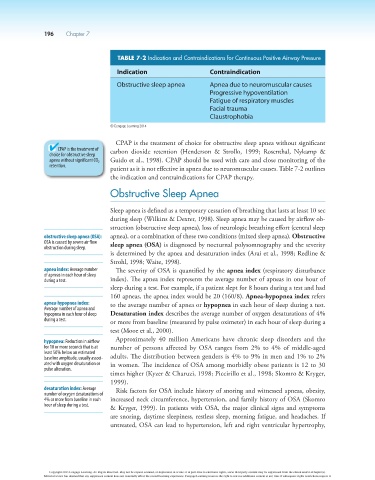
                                              TABLE 7-2 Indication and Contraindications for Continuous Positive Airway Pressure

                                              Indication                    Contraindication

                                              Obstructive sleep apnea       Apnea due to neuromuscular causes
                                                                            Progressive hypoventilation
                                                                            Fatigue of respiratory muscles
                                                                            Facial trauma
                                                                            Claustrophobia
                                            © Cengage Learning 2014

                                             CPAP is the treatment of choice for obstructive sleep apnea without significant
                          CPAP is the treatment of   carbon  dioxide  retention  (Henderson  &  Strollo,  1999;  Rosenthal,  Nykamp  &
                        choice for obstructive sleep
                        apnea without significant CO 2    Guido et al., 1998). CPAP should be used with care and close monitoring of the
                        retention.          patient as it is not effective in apnea due to neuromuscular causes. Table 7-2 outlines
                                            the indication and contraindications for CPAP therapy.

                                            Obstructive Sleep Apnea


                                            Sleep apnea is defined as a temporary cessation of breathing that lasts at least 10 sec
                                            during sleep (Wilkins & Dexter, 1998). Sleep apnea may be caused by airflow ob-
                                            struction (obstructive sleep apnea), loss of neurologic breathing effort (central sleep
                      obstructive sleep apnea (OSA):   apnea), or a combination of these two conditions (mixed sleep apnea). Obstructive
                      OSA is caused by severe air flow   sleep apnea (OSA) is diagnosed by nocturnal polysomnography and the severity
                      obstruction during sleep.
                                            is determined by the apnea and desaturation index (Arai et al., 1998; Redline &
                                            Strohl, 1998; Waite, 1998).
                      apnea index: Average number   The severity of OSA is quantified by the apnea index (respiratory disturbance
                      of apneas in each hour of sleep
                      during a test.        index). The apnea index represents the average number of apneas in one hour of
                                            sleep during a test. For example, if a patient slept for 8 hours during a test and had
                                            160 apneas, the apnea index would be 20 (160/8). Apnea-hypopnea index refers
                      apnea-hypopnea index:   to the average number of apnea or hypopnea in each hour of sleep during a test.
                      Average number of apnea and
                      hypopnea in each hour of sleep   Desaturation index describes the average number of oxygen desaturations of 4%
                      during a test.        or more from baseline (measured by pulse oximeter) in each hour of sleep during a
                                            test (Mooe et al., 2000).
                                             Approximately  40  million  Americans  have  chronic  sleep  disorders  and  the
                      hypopnea: Reduction in airflow
                      for 10 or more seconds that is at   number  of  persons  affected  by  OSA  ranges  from  2%  to  4%  of  middle-aged
                      least 50% below an estimated
                      baseline amplitude, usually associ-  adults. The distribution between genders is 4% to 9% in men and 1% to 2%
                      ated with oxygen desaturation or   in women. The incidence of OSA among morbidly obese patients is 12 to 30
                      pulse alteration.
                                            times higher (Kyzer & Charuzi, 1998; Piccirillo et al., 1998; Skomro & Kryger,
                                            1999).
                      desaturation index: Average   Risk factors for OSA include history of snoring and witnessed apneas, obesity,
                      number of oxygen desaturations of
                      4% or more from baseline in each   increased neck circumference, hypertension, and family history of OSA (Skomro
                      hour of sleep during a test.
                                            & Kryger, 1999). In patients with OSA, the major clinical signs and symptoms
                                            are snoring, daytime sleepiness, restless sleep, morning fatigue, and headaches. If
                                            untreated, OSA can lead to hypertension, left and right ventricular hypertrophy,


                        Copyright 2013 Cengage Learning. All Rights Reserved. May not be copied, scanned, or duplicated, in whole or in part. Due to electronic rights, some third party content may be suppressed from the eBook and/or eChapter(s).
                      Editorial review has deemed that any suppressed content does not materially affect the overall learning experience. Cengage Learning reserves the right to remove additional content at any time if subsequent rights restrictions require it.

