


Page 237 - Clinical Application of Mechanical Ventilation
P. 237
Noninvasive Positive Pressure Ventilation  203


                                                                                                       Used with permission by Philips Healthcare


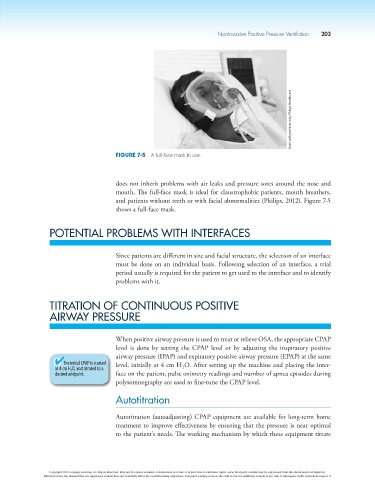
                                             Figure 7-5  A full-face mask in use.


                                             does not inherit problems with air leaks and pressure sores around the nose and
                                             mouth. The full-face mask is ideal for claustrophobic patients, mouth breathers,
                                             and patients without teeth or with facial abnormalities (Philips, 2012). Figure 7-5
                                             shows a full-face mask.


                        POTENTIAl PROBlEmS wITh INTERfACES


                                             Since patients are different in size and facial structure, the selection of an interface
                                             must be done on an individual basis. Following selection of an interface, a trial
                                             period usually is required for the patient to get used to the interface and to identify
                                             problems with it.


                        TITRATION Of CONTINUOUS POSITIVE
                        AIRwAy PRESSURE


                                             When positive airway pressure is used to treat or relieve OSA, the appropriate CPAP
                                             level is done by setting the CPAP level or by adjusting the inspiratory positive
                                             airway pressure (IPAP) and expiratory positive airway pressure (EPAP) at the same
                            The initial CPAP is started   level, initially at 4 cm H O. After setting up the machine and placing the inter-
                          at 4 cm H 2 O, and titrated to a         2
                          desired endpoint.  face on the patient, pulse oximetry readings and number of apnea episodes during
                                             polysomnography are used to fine-tune the CPAP level.

                                             Autotitration


                                             Autotitration (autoadjusting) CPAP equipment are available for long-term home
                                             treatment to improve effectiveness by ensuring that the pressure is near optimal
                                             to the patient’s needs. The working mechanism by which these equipment titrate


                        Copyright 2013 Cengage Learning. All Rights Reserved. May not be copied, scanned, or duplicated, in whole or in part. Due to electronic rights, some third party content may be suppressed from the eBook and/or eChapter(s).
                      Editorial review has deemed that any suppressed content does not materially affect the overall learning experience. Cengage Learning reserves the right to remove additional content at any time if subsequent rights restrictions require it.

