


Page 249 - Clinical Application of Mechanical Ventilation
P. 249
Initiation of Mechanical Ventilation  215


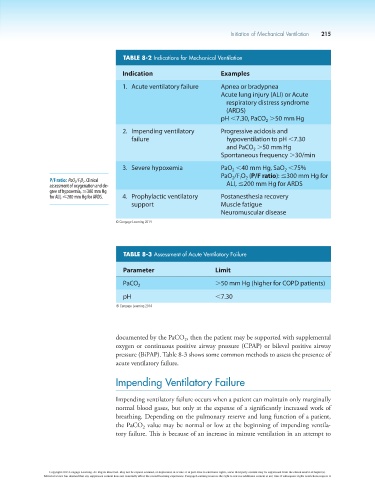
                                                TABLE 8-2 Indications for Mechanical Ventilation

                                                Indication                      Examples

                                                1.	 Acute	ventilatory	failure   Apnea	or	bradypnea
                                                                                Acute	lung	injury	(ALI)	or	Acute
                                                                                  respiratory	distress	syndrome
                                                                                  (ARDS)
                                                                                pH	,7.30,	PaCO 	.50	mm	Hg
                                                                                              2
                                                2.	 Impending	ventilatory	      Progressive	acidosis	and
                                                 	 failure                        hypoventilation	to	pH	,7.30
                                                                                  and	PaCO 	.50	mm	Hg
                                                                                          2
                                                                                Spontaneous	frequency	.30/min

                                                3.	 Severe	hypoxemia            PaO 	,40	mm	Hg,	SaO 	,75%
                                                                                   2
                                                                                                    2
                                                                                PaO /F O 	(P/F ratio):	≤300	mm	Hg	for
                        P/F ratio: PaO 2  / F I O 2 . Clinical                     2  I  2
                        assessment of oxygenation and de-                         ALI,	≤200	mm	Hg	for	ARDS
                        gree of hypoxemia, ≤300 mm Hg
                        for ALI, ≤200 mm Hg for ARDS.  4.	 Prophylactic	ventilatory	  Postanesthesia	recovery
                                                 	 support                      Muscle	fatigue
                                                                                Neuromuscular	disease
                                             © Cengage Learning 2014


                                                TABLE 8-3 Assessment of Acute Ventilatory Failure

                                                Parameter                     Limit

                                                PaCO 2                        .50	mm	Hg	(higher	for	COPD	patients)

                                                pH                            ,7.30
                                              © Cengage Learning 2014


                                             documented by the PaCO , then the patient may be supported with supplemental
                                                                    2
                                             oxygen or continuous positive airway pressure (CPAP) or bilevel positive airway
                                             pressure (BiPAP). Table 8-3 shows some common methods to assess the presence of
                                             acute ventilatory failure.


                                             Impending Ventilatory Failure


                                             Impending ventilatory failure occurs when a patient can maintain only marginally
                                             normal blood gases, but only at the expense of a significantly increased work of
                                             breathing. Depending on the pulmonary reserve and lung function of a patient,
                                             the PaCO  value may be normal or low at the beginning of impending ventila-
                                                      2
                                             tory failure. This is because of an increase in minute ventilation in an attempt to


                        Copyright 2013 Cengage Learning. All Rights Reserved. May not be copied, scanned, or duplicated, in whole or in part. Due to electronic rights, some third party content may be suppressed from the eBook and/or eChapter(s).
                      Editorial review has deemed that any suppressed content does not materially affect the overall learning experience. Cengage Learning reserves the right to remove additional content at any time if subsequent rights restrictions require it.

