


Page 250 - Clinical Application of Mechanical Ventilation
P. 250
216    Chapter 8


                                            compensate for the gas exchange deficiencies. However, if the underlying pathology
                                            is not corrected in time, ventilatory failure will ensue when muscle fatigue occurs
                                            as a result of prolonged, excessive work of breathing. At this time, the PaCO  will
                                                                                                             2
                                            rise and the pH will fall.
                                             If the early clinical signs indicate that a patient is in impending ventilatory failure,
                                            it is appropriate to initiate mechanical ventilation. Early intervention is done to cor-
                                            rect hypoxemia and acidosis imposed on the major organs and to reduce the stress
                                            placed on the cardiopulmonary system. There are several objective measurements
                                            that can be used to determine whether the patient is in impending ventilatory fail-
                                            ure. These measurements are discussed below.
                                            Assessment of Impending Ventilatory Failure. Development of impending ventilatory
                          Assessment of
                        impending ventilatory failure   failure  is  dependent on  the  balance of  metabolic  needs  and  work of breathing.
                        relies on the measurements   When metabolic needs cause excessive work of breathing, impending ventilatory
                        related to the lung functions
                        (i.e., V T , f, V E , VC, MIP).  failure is likely. Since the work of breathing is carried out entirely by the respiratory
                                            system, assessment of impending ventilatory failure relies solely on the measure-
                                            ments related to the lung functions (i.e., tidal volume, frequency, minute volume,
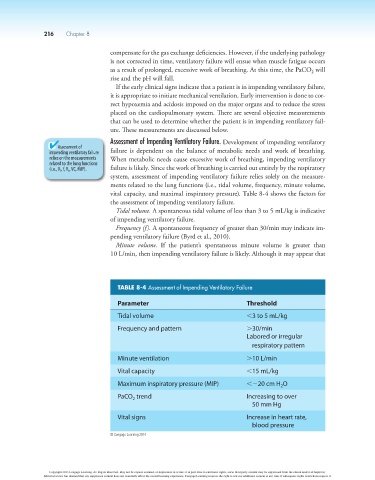
                                            vital capacity, and maximal inspiratory pressure). Table 8-4 shows the factors for
                                            the assessment of impending ventilatory failure.
                                             Tidal volume. A spontaneous tidal volume of less than 3 to 5 mL/kg is indicative
                                            of impending ventilatory failure.
                                             Frequency (f). A spontaneous frequency of greater than 30/min may indicate im-
                                            pending ventilatory failure (Byrd et al., 2010).
                                             Minute  volume.  If  the  patient’s  spontaneous  minute  volume  is  greater  than
                                            10 L/min, then impending ventilatory failure is likely. Although it may appear that


                                              TABLE 8-4 Assessment of Impending Ventilatory Failure

                                              Parameter                                 Threshold

                                              Tidal	volume                              ,3	to	5	mL/kg
                                              Frequency	and	pattern                     .30/min
                                                                                        Labored	or	irregular
                                                                                          respiratory	pattern
                                              Minute	ventilation                        .10	L/min

                                              Vital	capacity                            ,15	mL/kg

                                              Maximum	inspiratory	pressure	(MIP)	       ,220	cm	H O
                                                                                                   2
                                              PaCO 	trend                               Increasing	to	over
                                                   2
                                                                                          50	mm	Hg
                                              Vital	signs                               Increase	in	heart	rate,
                                                                                          blood	pressure
                                            © Cengage Learning 2014


                        Copyright 2013 Cengage Learning. All Rights Reserved. May not be copied, scanned, or duplicated, in whole or in part. Due to electronic rights, some third party content may be suppressed from the eBook and/or eChapter(s).
                      Editorial review has deemed that any suppressed content does not materially affect the overall learning experience. Cengage Learning reserves the right to remove additional content at any time if subsequent rights restrictions require it.

