


Page 253 - Clinical Application of Mechanical Ventilation
P. 253
Initiation of Mechanical Ventilation  219


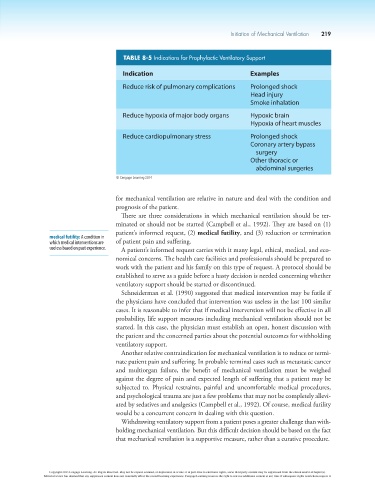
                                                TABLE 8-5 Indications for Prophylactic Ventilatory Support

                                                Indication                               Examples

                                                Reduce	risk	of	pulmonary	complications   Prolonged	shock
                                                                                         Head	injury
                                                                                         Smoke	inhalation

                                                Reduce	hypoxia	of	major	body	organs      Hypoxic	brain
                                                                                         Hypoxia	of	heart	muscles

                                                Reduce	cardiopulmonary	stress            Prolonged	shock
                                                                                         Coronary	artery	bypass
                                                                                           surgery
                                                                                         Other	thoracic	or
                                                                                           abdominal	surgeries
                                              © Cengage Learning 2014


                                             for mechanical ventilation are relative in nature and deal with the condition and
                                             prognosis of the patient.
                                               There are three considerations in which mechanical ventilation should be ter-
                                             minated or should not be started (Campbell et al., 1992). They are based on (1)
                                             patient’s informed request, (2) medical futility, and (3) reduction or termination
                        medical futility: A condition in
                        which medical interventions are   of patient pain and suffering.
                        useless based on past experience.  A patient’s informed request carries with it many legal, ethical, medical, and eco-
                                             nomical concerns. The health care facilities and professionals should be prepared to
                                             work with the patient and his family on this type of request. A protocol should be
                                             established to serve as a guide before a hasty decision is needed concerning whether
                                             ventilatory support should be started or discontinued.
                                               Schneiderman et al. (1990) suggested that medical intervention may be futile if
                                             the physicians have concluded that intervention was useless in the last 100 similar
                                             cases. It is reasonable to infer that if medical intervention will not be effective in all
                                             probability, life support measures including mechanical ventilation should not be
                                             started. In this case, the physician must establish an open, honest discussion with
                                             the patient and the concerned parties about the potential outcomes for withholding
                                             ventilatory support.
                                               Another relative contraindication for mechanical ventilation is to reduce or termi-
                                             nate patient pain and suffering. In probable terminal cases such as metastatic cancer
                                             and  multiorgan  failure,  the  benefit  of  mechanical  ventilation  must  be  weighed
                                             against the degree of pain and expected length of suffering that a patient may be
                                             subjected to. Physical restraints, painful and uncomfortable medical procedures,
                                             and psychological trauma are just a few problems that may not be completely allevi-
                                             ated by sedatives and analgesics (Campbell et al., 1992). Of course, medical futility
                                             would be a concurrent concern in dealing with this question.
                                               Withdrawing ventilatory support from a patient poses a greater challenge than with-
                                             holding mechanical ventilation. But this difficult decision should be based on the fact
                                             that mechanical ventilation is a supportive measure, rather than a curative procedure.


                        Copyright 2013 Cengage Learning. All Rights Reserved. May not be copied, scanned, or duplicated, in whole or in part. Due to electronic rights, some third party content may be suppressed from the eBook and/or eChapter(s).
                      Editorial review has deemed that any suppressed content does not materially affect the overall learning experience. Cengage Learning reserves the right to remove additional content at any time if subsequent rights restrictions require it.

